
 English
 Español
 Deutsch
Chat on WhatsApp
+1 (617) 987-7432
You just filled 5,000 units. They look perfect going into the box.
Two weeks later, a retailer sends photos: sticky residue leaking from the bottom seal. A customer posts a video of a spout pouch dripping onto their counter. Your returns are climbing, and you cannot figure out why.
The problem is not your product. It is not your filling machine.
It is the fundamental difference in how spouted pouches and flat (non-fitment) pouches create and maintain a seal under real-world conditions.
This comparison breaks down both formats across six critical dimensions: seal geometry, failure modes, filling line stress, material compatibility, leak resistance, and shelf-life reliability.
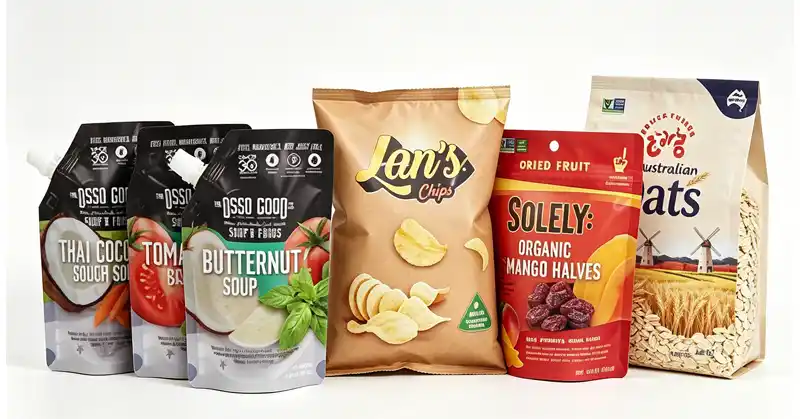
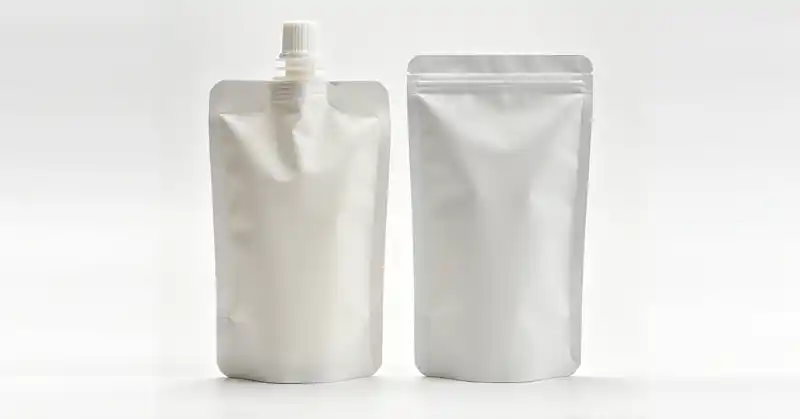
| Feature | Spouted Pouch (Fitment) | Flat Premade Pouch (No Fitment) |
|---|---|---|
| Primary seal location | Fitment-to-film interface (around the spout) + bottom seal | Bottom seal + side seals (full perimeter) |
| Number of seal points | 2-3 (spout, bottom, optional zipper) | 1-2 (bottom only, or bottom + zipper) |
| Critical failure zone | Spout base — where rigid plastic meets flexible film | Bottom gusset corners — where folds create stress points |
| Seal type | Thermal + mechanical (spout is inserted) | Thermal only |
The key insight: A spouted pouch introduces a dissimilar material junction (rigid PE/PP spout to flexible multi-layer film). This is always the highest leak risk. A flat pouch uses the same film throughout—only heat and pressure create the seal.
In controlled testing (ASTM F88/F2058 standard), both formats can achieve good initial seal strength when properly made. The values below are typical reference ranges, not guaranteed specifications; actual results depend on the specific film structure, seal parameters, and testing conditions.
| Test Parameter | Spouted Pouch | Flat Premade Pouch |
|---|---|---|
| Peak seal force (N/15mm) | Typically lower and more variable (spout dependent) | Typically higher and more consistent |
| Failure mode | Adhesive peel (spout-film) | Cohesive (film tears before seal) |
| Consistency | Higher variation | Lower variation |
Winner for lab performance: Flat pouch, due to uniform material and simpler seal geometry.
However, laboratory conditions do not include shipping, temperature swings, or customer handling.
This is where the two formats diverge dramatically.
Spouted Pouch Failure Modes (Most Common):
| Failure Point | Root Cause | Frequency |
|---|---|---|
| Spout base leak | Poor fitment insertion temperature or pressure | Moderate-High |
| Cap thread leak | Cross-threading or insufficient liner seal | Moderate |
| Bottom seal leak | Secondary — usually from shipping stress | Low |
Flat Premade Pouch Failure Modes (Most Common):
| Failure Point | Root Cause | Frequency |
|---|---|---|
| Bottom gusset corner pinhole | Film stretched too thin during gusset forming | Low-Moderate |
| Side seal creep | Excessive pressure during filling line transport | Low |
| Zipper track leak (if present) | Powder contamination in seal area | Moderate (powders only) |
Real-world observation: For liquid products, spouted pouches generally show higher field leak rates than flat pouches of the same volume—most often at the spout-film junction. The exact difference depends on the specific spout design, film structure, filling process, and distribution environment.
Your filling line is not gentle. Vibrations, indexing movements, and sealing jaw impacts all stress the seals before the product even ships.
| Stress Factor | Spouted Pouch | Flat Premade Pouch |
|---|---|---|
| Fitment insertion stress | High — spout must be forced into film opening | Not applicable |
| Seal bar impact sensitivity | Moderate (bottom seal only) | Moderate (bottom seal only) |
| Conveyor vibration effect on seals | Low — spout adds rigidity | Low-Moderate |
| Dropped bag test (500mm) | Spout can crack or leak at base | Corner seal can fail if over-stressed |
Winner for filling line forgiveness: Flat pouch. Fewer variables = fewer things to go wrong.
However, spouted pouches offer undeniable user convenience for certain products.
Different products require different seal integrity levels.
| Product Type | Spouted Pouch Suitability | Flat Premade Pouch Suitability | Reasoning |
|---|---|---|---|
| Low-viscosity liquids (water, juice) | Good — but test spout seal | Excellent — fewer leak paths | Flat pouches have no fitment junction |
| High-viscosity pastes (honey, ketchup) | Good — spout aids dispensing | Very Good — but dispensing is harder | Choose spout for dispensing, flat for leak prevention |
| Oily products (olive oil, sauces) | Moderate — oil can wick through spout-film interface | Excellent — uniform seal material | Oil migration is a risk with dissimilar materials |
| Powders (protein, flour) | Poor — powder bridges in spout | Excellent — simple open top | Spouts clog; flat pouches fill easily |
| Carbonated beverages | Very Poor — spouts cannot hold pressure | Not applicable (carbonated not recommended) | Neither is ideal for carbonation |
| Hot-filled products (>85°C) | Poor — spout material can deform | Good (with appropriate film) | Heat affects fitment seal integrity |
Why would anyone choose a spouted pouch if flat pouches seal better?
Because spouted pouches solve a different problem: dispensing and resealability.
A spouted pouch with a cap allows one-handed, no-mess dispensing.
A flat pouch requires pouring or scooping—messier and less precise.
So the question is not “which seals better in a vacuum?” The question is: “For my specific product and use case, is the dispensing convenience worth the higher leak risk?”
| Use Case | Recommended Format | Primary Rationale |
|---|---|---|
| Baby food / applesauce (single-serve) | Spouted pouch | Dispensing ease outweighs moderate leak risk |
| Protein powder (bulk) | Flat pouch | No clogging; superior seal reliability |
| Liquid detergent (refill) | Spouted pouch | Controlled pouring; cap reseals |
| Cold brew coffee (retail) | Flat pouch with fitment? | Test both. Spout for fridge dispensing; flat for shelf stability |
| Edible oils (gourmet) | Flat pouch | Oil migration risk with spouts is too high |
| Cannabis tinctures | Spouted pouch | Dropper-style dispensing requires spout |
Whichever format you choose, do not rely on supplier data alone. Run these checks on your actual production line, with your actual product.
1. Dye Penetration for Nonporous Pouches (ASTM F3039)
Apply dye penetrant to the seal edge and inspect for dye migration through the seal. This method is applicable to nonporous flexible packaging, including all-plastic laminate pouches such as PET/PE, PET/NY/PE, and PET/AL/PE—the structures used for spouted and flat premade pouches alike. It detects leaks equal to or greater than a channel formed by a 50 µm wire in edge seals. Do not use ASTM F1929 for these pouches: that standard is limited to porous medical packaging (edge seals formed between a transparent material and a porous sheet material such as Tyvek®) and is not applicable to food pouches where neither seal surface is porous. For a deeper comparison of ASTM leak test methods and their applicable package types, see our seal integrity testing guide.
2. Burst Test (ASTM F2054)
Pressurize sealed pouches until they burst. Record the pressure. This method applies to flexible packages with seals placed around the perimeter. For spouted pouches, the burst test primarily evaluates the bottom and perimeter seals; the spout-to-film junction may require a separate leak test method better suited to dissimilar material seals.
3. Real-world Shipment Simulation
While standardized tests like ASTM F3039 and F2054 evaluate specific seal properties, they do not replicate the combined stresses of a full distribution cycle. A practical supplement is to fill a representative batch of each format—at least 30 units per format—and ship them via your actual distribution channel. After the shipment, inspect every unit for seal integrity. This is not a standardized test, but it surfaces issues that bench tests may miss under your specific logistics conditions.
Ask four questions:
| Question | Yes → Consider Spouted | No or Maybe → Start with Flat |
|---|---|---|
| Does your product require precise, no-mess dispensing? | Yes — spout adds value | Flat pouch with pour spout? Unlikely |
| Is your product low-viscosity and non-oily? | Yes — lower leak risk | Oil or high viscosity → flat is safer |
| Will the pouch be used one-handed (on-the-go)? | Yes — spout is superior | Flat requires two hands |
| Is dispensing convenience more important than minimizing leak risk? | Yes — if dispensing is critical | No → flat is your answer |
Flat pre-made pouches seal better in every controlled test. They have fewer failure points, no dissimilar material junctions, and more consistent seal strength.
Spouted pouches seal adequately for many liquid applications—but the spout-to-film interface is always the weakest link. The convenience of a resealable cap may be worth that trade-off, depending on your product and customer expectations.
Recommendation:
Start with flat pre-made pouches for powders, oils, high-viscosity pastes, or any product where leak prevention is your #1 priority.
Choose spouted pouches only when dispensing convenience directly drives repeat purchases (baby food, liquid refills, on-the-go beverages).
Review material options, seal specifications, and pricing for both formats.
If you are still unsure which format matches your product’s viscosity, pH, and distribution path, contact Wizpackaging for a free packaging consultation. We will help you quantify the trade-off between dispensing convenience and seal reliability—with data, not guesses.
Chat on WhatsApp
+1 (617) 987-7432