
 English
 Español
 Deutsch
Chat on WhatsApp
+1 (617) 987-7432
Selecting a preformed pouch for your product involves more than just size and appearance. The requirements for a dry snack, a moist pet treat, or a chemical powder differ fundamentally in terms of barrier protection, physical durability, and regulatory compliance. Many procurement and product teams face the challenge of translating their product’s technical needs into the correct pouch specifications.
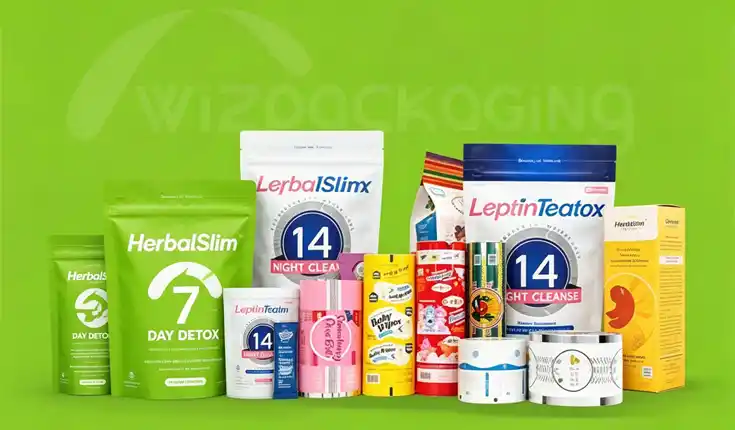
This article provides a decision framework based on three high-demand sectors: human food, pet food/snacks, and agricultural/chemical products. You will learn the key technical differentiators to look for—from material structure to seal integrity—so you can better communicate your needs to potential packaging suppliers.
The functional demands of a ready-made pouch are dictated almost entirely by the product it will contain and its supply chain environment. Below is a breakdown of the primary technical drivers for each of the three sectors.
| Sector | Primary Technical Drivers | Why It Matters for Your Product | Common Pouch Styles |
|---|---|---|---|
| Human Food | High oxygen/moisture barrier, flavour protection, compliance with food-contact regulations (e.g., FDA, EU) | Prevents staleness, colour fading, or off-flavours; ensures consumer safety. | Stand-up pouch, flat-bottom pouch, spouted pouch for liquids/sauces. |
| Pet Food & Snacks | Puncture resistance (for bones/treats), high grease/oil barrier, large-format resealability | Prevents package failure from sharp edges; avoids oil staining on shelves; maintains product freshness after opening. | Side gusset pouch, doypack with zipper, quad-seal bag. |
| Agricultural/Chemical | Chemical resistance, high mechanical strength, UV protection, UN certification for certain goods | Prevents leakage or degradation of aggressive formulations; ensures worker safety and regulatory transit compliance. | Heavy-duty stand-up pouch, multi-layer laminated bag, foil-based barrier pouch. |
For a deeper understanding of how material structure meets these functional needs, you can review the design approaches explained in the custom bag styles overview.
Barrier performance is the most critical, yet commonly misunderstood, specification. It refers to a pouch's ability to prevent gases (oxygen), moisture, and light from passing through. According to the Flexible Packaging Association (FPA) and related industry case data, specifying the correct barrier level can extend product shelf life for sensitive goods. Reported improvements vary widely by product and packaging format—for example, vacuum-sealed flexible packaging has been cited as extending fresh meat shelf life by up to 300% compared to conventional packaging, cheese staying fresh about 60% longer in flexible vacuum-sealed bags, and pre-cut salad retaining freshness up to 10 days longer in breathable film packaging. These figures come from specific studies and supplier case data, not from a single universal benchmark. They should be treated as directional references only, and shelf life should be validated based on your specific product, packaging structure, and storage conditions.
For Human Food (e.g., coffee, nuts, dried fruit):
Requirement: High oxygen barrier (often <1 cc/m²/day) and high moisture barrier.
Interpretation for your product: A high oxygen barrier means the pouch will keep roasted nuts crispy and prevent the oils from going rancid for 12–18 months. A high moisture barrier prevents powdery items (like protein powder or baking mix) from clumping.
Typical material: Multi-layer laminate using aluminum foil (e.g., PET / LDPE / Al foil / LDPE / nylon / LDPE / EVA, with OTR and WVTR often below 0.16 cc/m²/day and 0.16 g/m²/day respectively), EVOH-based coextruded films (typically 3–7 layers with EVOH as the oxygen barrier core, OTR 0.5–3 cc/m²/day at 23°C / 0% RH but degrading above 75% RH), or other high-barrier transparent films (metallized PET, SiOx/AlOx coated films).
For Pet Food & Snacks (e.g., jerky, dental chews, kibble):
Requirement: Extremely high oil/grease resistance and puncture resistance, with moderate to high oxygen barrier.
Interpretation for your product: Grease resistance prevents unsightly seepage. Puncture resistance ensures that sharp-edged treats do not poke holes in the pouch during shipping, which would lead to spoilage or insect infestation.
Typical material: Thicker gauge laminates with sealant layers specifically formulated to resist oil migration.
For Agricultural/Chemical (e.g., fertilizer, seed treatment, chlorine tablets):
Requirement: Chemical inertness, UV light barrier, and high tensile strength.
Interpretation for your product: A chemical-resistant inner layer prevents the pouch’s own material from degrading when in contact with aggressive contents. UV protection is essential for products that degrade under sunlight. Industry data from the American Chemistry Council (ACC) indicates that improper packaging for chemical intermediates is a leading cause of preventable supply chain incidents.
Typical material: Heavy-gauge clear or foil laminates with specialized sealants or co-extruded barrier films.
Structural note: Aluminum foil and EVOH are fundamentally different barrier materials and should not be treated as interchangeable. Aluminum foil is a metallic layer (typically 6–20 µm, commonly 9–12 µm) that provides near-absolute oxygen and moisture barrier regardless of humidity. EVOH is a hydrophilic copolymer that offers excellent oxygen barrier in dry conditions but loses barrier performance above approximately 75% RH; it must be protected by moisture-resistant outer layers. Multilayer EVOH structures (e.g., 4 EVOH layers with adhesive and PP/PE tie layers) can approach foil-level OTR and WVTR values in oriented and laminated configurations, and outperform foil in flex-crack resistance. The choice between foil and EVOH should be driven by transparency requirements, retort conditions, humidity exposure, and recyclability goals.
Beyond barrier properties, mechanical durability is non-negotiable. Use this step-by-step method to evaluate whether a ready-made pouch design suits your product’s physical demands.
Ask yourself: How will my product be inserted into the pouch? If it is a fine powder, you need a pouch design that allows for clean, dust-free filling (e.g., a flat-bottom pouch that stands open). If it is a heavy liquid, the bottom seal must be wide and robust to prevent blowouts.
Product-filled pouches undergo pressure in palletized storage and drops during transit. For heavy pet treats or chemical granules, request data or samples to test the seal strength. A common failure point is the side gusset seal under dynamic load.
Food: A clear, one-handed resealable zipper adds consumer convenience.
Pet Food: A heavy-duty press-to-close or slider zipper is preferred for large quantities (e.g., 5–10 lb sizes).
Chemical: Often requires a non-resealable, tamper-evident seal or a heat-sealed top to prevent accidental exposure.
Food & Pet Food: The finished pouch must be manufactured in a facility with GMP controls to prevent cross-contamination.
Chemical: Check if your product class requires specific UN certification for packaging—standard ready-made pouches are rarely UN-certified unless specially ordered.
To see how these durability factors translate into different bag constructions, visit the sustainable packaging solutions section, which also covers material compatibility.
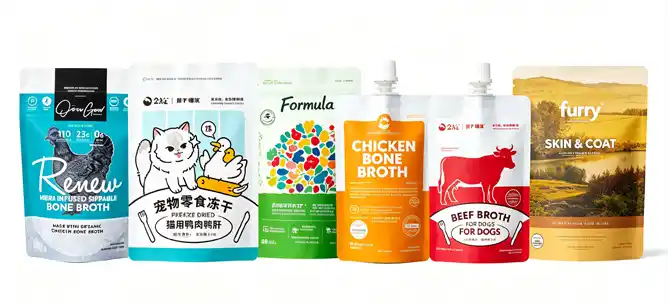
Key concern: Maintaining crispness of nuts and pretzels for 9 months while displaying product through a clear window.
Critical spec: High-barrier clear laminate (without foil) that still achieves oxygen transmission rates below 2 cc/m²/day. Suitable options include metallized PET (MET-PET) laminates or EVOH-based coextruded films with moisture-resistant outer layers.
Why standard pouches fail: Many generic clear pouches do not provide this level of barrier; only engineered clear barrier films (MET-PET or EVOH-based structures) work. Standard PE-only pouches have OTR values of 30–50 cc/m²/day, far above the required threshold.
Key concern: Oil from the chews staining the inside of the pouch and migrating to the exterior, ruining shelf appearance.
Critical spec: A sealant layer with high oil resistance, plus a matte outer finish that masks any minor scuffing.
Why standard pouches fail: Standard polyethylene sealant layers absorb oil, leading to delamination and visible stains.
Key concern: Preventing the pouch from absorbing moisture from the air (which causes clumping) and ensuring the fill spout does not clog.
Critical spec: A foil barrier pouch with an anti-static inner layer to reduce powder cling. A flat-bottom style with a wide opening for easy filling. Note: if a transparent pouch is preferred, EVOH-based structures can provide a high oxygen barrier but require effective moisture protection because EVOH loses barrier performance above approximately 75% RH.
Why standard pouches fail: Without anti-static properties, fine powder bridges across the opening, making automated filling impossible. Additionally, pouches without adequate moisture barrier allow humidity ingress, causing fertilizer clumping.
For customized packaging solutions tailored to specific products, please refer to the custom pouch packaging page from Wiz Packaging.
Once you have identified the primary drivers for your sector—be it oxygen barrier for food, puncture resistance for pet treats, or chemical inertness for agricultural goods—you are ready to translate these needs into a technical specification sheet. The goal is to communicate required performance levels, not just dimensions.
A clear next step is to request material structure samples that align with your highest-priority requirement. For example, ask potential suppliers: “What clear laminate structures do you offer with verified oxygen transmission rates below 2 cc/m²/day at 23°C / 0% RH, and can you provide a certificate of conformance for food-contact safety?”
When comparing foil versus EVOH options, also ask: “What is the EVOH layer thickness and protection structure, and what OTR value can be guaranteed at 75% RH or higher? For foil structures, what is the foil layer thickness and the T-peel strength of the laminate?”
To continue building your knowledge base, consider reviewing a comparative guide on printed rollstock versus preformed pouches for high-speed filling lines, which addresses another major packaging decision point.
Chat on WhatsApp
+1 (617) 987-7432