
 English
 Español
 Deutsch
Chat on WhatsApp
+1 (617) 987-7432
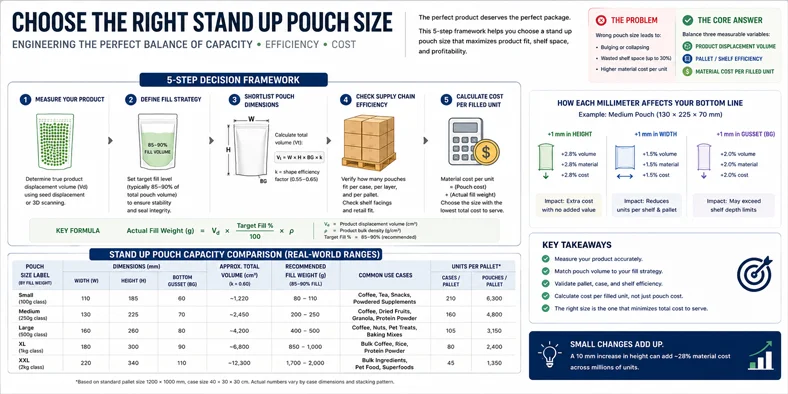
You’ve formulated the perfect product—artisanal coffee, freeze-dried fruits, or probiotic powder. But when you test the first prototype stand up pouch, it either bulges awkwardly, wastes 30% of shelf space, or collapses under its own weight. The core answer: Choosing the correct stand up pouch size requires balancing three measurable variables—product displacement volume, pallet/shelf efficiency, and material cost per filled unit. This guide walks you through a 5-step decision framework, includes a comparison table of real-world capacity ranges, and quantifies how each millimeter of dimension affects your bottom line. No sales pitch, just engineering logic.
Bottom gusset – the folded inward panel that expands when filled. A wider gusset (e.g., 40mm vs 30mm) increases standing stability by ~20% but adds 8–12% more film material. Business impact: For heavy products like 1kg pet treats, a wider gusset prevents tipping on shelves; for lightweight snacks, it’s unnecessary cost.
Most pouches lose 15–25mm at the top for sealing. A 200mm tall pouch may only offer 175mm internal height. Business impact: Underestimating this leads to underfilling or resealing failures. Always add 20mm to your required fill height.
Explore packaging solutions for high-moisture products →
The table below quantifies typical ranges for stand up pouches. Use these as benchmarks, not absolute rules.
| Comparison Dimension | Small / Single-serve (50–200g) | Large / Family or Bulk (500–1500g) | Application Guidance |
|---|---|---|---|
| Typical volume range (cm³) | 150 – 500 cm³ | 800 – 2500 cm³ | Snacks, spices vs. flour, pet food |
| Bottom gusset width | 25 – 35 mm | 40 – 70 mm | Wider gusset = higher material cost (+8-12%) but better display stability |
| Fill speed impact (bags/min on rotary filler) | Up to 70 bags/min | 40 – 50 bags/min | Business value: Small pouches increase hourly output by 40% – critical for contract packers. |
| Material cost as % of total package | 12 – 18% | 22 – 30% | Larger pouches use heavier films (more plies) – trade-off with freight efficiency. |
| Pallet density (units per euro pallet) | 8,000 – 12,000 | 1,500 – 3,000 | Small sizes reduce shipping cost per unit but increase handling time. |
Quantified insight: Increasing bottom gusset by 10mm raises material consumption by ~0.8g per pouch (for a 200×300mm lay-flat size). For 1 million units, that’s 800kg of extra laminate – equivalent to ~$2,400 in film cost at $3/kg. Use the narrowest gusset that still passes drop tests.
Follow these steps to determine your exact size specification – no guessing.
View standard dimension series for dry food & snacks →
Density: 0.42 g/cm³. Required volume = 340/0.42 = 810 cm³. Headspace for CO₂: add 10% → 891 cm³. Choose width 140mm, height 220mm, gusset 50mm → volume = (140×220×50)/2 = 770,000 mm³ (770 cm³) – slightly low. Increase height to 240mm → 840 cm³ perfect. Top 3 criteria: degassing valve compatibility > oxygen barrier > size consistency with retail shelf (fits Starbucks bag footprint).
Very low density: 0.12 g/cm³. Volume needed = 200/0.12 = 1667 cm³. Wide gusset critical (70mm) to prevent bulging. Dimensions: width 200mm, height 280mm, gusset 70mm → volume = (200×280×70)/2 = 1,960,000 mm³ → ample. Top 3 criteria: puncture resistance (sharp edges) > resealable zipper > large printable area for nutrition facts.
Similar needs? See our industry page for freeze-dried products.
Q1: What is the minimum order quantity for custom-sized stand up pouches? MOQs vary by supplier and whether custom printing or plain stock. For plain pre-made pouches with standard sizes, you can find as low as 500-1000 units. For fully custom dimensions with rotogravure printing, typical MOQs range from 10,000 to 50,000 pieces. Always ask for “stock size” first if you need low volume.
Q2: How do I measure a stand up pouch’s dimensions correctly? Measure three values: lay-flat width (side to side), lay-flat height (top seal to bottom edge), and bottom gusset width (folded inward). Never measure the filled pouch because film stretches. Use a rigid ruler on an empty, flat pouch.
Q3: Can I use one pouch size for multiple product weights? Yes, but only within a range. A 1-liter volume pouch can fit 200g of low-density cereal (5x expansion) or 800g of high-density powder. However, headspace may cause oxygen damage for sensitive products. Best practice: each SKU gets its own size calculated via density method.
Q4: What are the standard stand up pouch sizes available without mold fees? Common stock sizes (in mm): 120×180×35, 140×200×40, 160×240×50, 180×280×65, 200×300×75. These cover most dry foods from 100g to 1000g. No tooling charges, lead times 2-4 weeks.
Q5: How does pouch size affect shipping costs? Larger pouches increase dimensional weight (DIM weight). For air freight, a 200×300×75mm pouch has DIM weight ~1.2kg, while a 140×200×40mm is ~0.4kg – triple the cost per unit. Always optimize for case pack efficiency.
Q6: Does stand up pouch size influence seal strength? Indirectly. Larger pouches require longer seal bars; inconsistent heat distribution across a 350mm seal can weaken edges. For pouches over 250mm width, request servo-driven sealers with temperature profiling.
Selecting the right stand up pouch size boils down to three core metrics: product density → required volume → shelf/freight efficiency. Always add 15% margin for headspace, validate with your filling machine’s jaw width, and run a material cost vs. freight trade-off. For most B2B buyers, starting with a stock size that matches 80% of your volume is smarter than immediate custom tooling.
Chat on WhatsApp
+1 (617) 987-7432