
 English
 Español
 Deutsch
Chat on WhatsApp
+1 (617) 987-7432
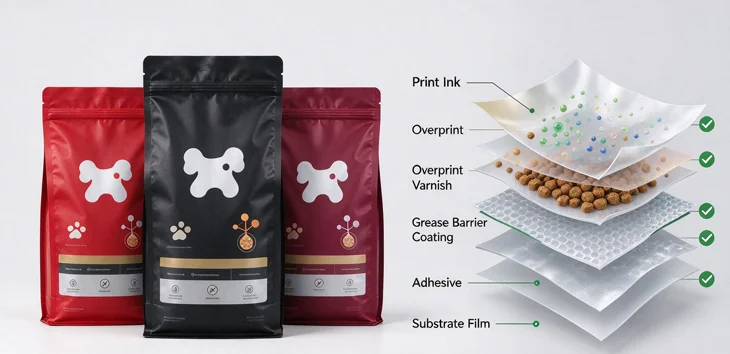
Since 12 August 2026, PFAS limits apply to the entire packaging unit—not just the film, but also inks, varnishes, coatings, and adhesives. For pet food and treat pouches that need grease resistance, this is a direct compliance question. The key is verifying total fluorine content and obtaining a supplier declaration that covers every component, not just the substrate.
The PPWR PFAS limits are not a material ban—they are concentration thresholds. For food-contact packaging, the limits are: individual PFAS below 25 ppb, the sum of PFAS below 250 ppb, and total PFAS (including non-targeted analysis) below 50 ppm.
The critical detail that caught many converters and brand owners off guard: the limits apply to the whole packaging unit. The European Commission’s FAQ clarifies that printing inks, varnishes, coatings, adhesives, and other components are all included, and it makes no difference whether PFAS were intentionally added or present as an impurity.
For pet food pouches, this matters most where grease resistance is required. Traditional grease barriers often relied on fluorochemical treatments. If a pouch uses a fluorinated coating on the inner or outer layer, the entire bag may exceed the threshold—even if the film itself is PFAS-free.
| Pouch component | Typical PFAS risk | What to ask |
|---|---|---|
| Outer print ink | Some inks use fluorinated additives for flow or adhesion | Ink supplier declaration; total fluorine data |
| Overprint varnish | Fluorinated slip agents possible | Varnish formulation confirmation |
| Grease barrier coating | Historically the highest risk for treat bags | Fluorine-free alternative confirmation (silicon, wax, or physical barrier) |
| Adhesive layer | Less common but must be covered by declaration | Adhesive supplier statement |
| Substrate film | Usually low risk in PE/PP mono structures | Film supplier declaration |
The grease barrier row is the one to examine first. Pet treats with high fat content—jerky, freeze-dried meat, oily kibble—often require an oil-resistant layer. If your current pouch performs well on grease resistance and you do not know why, that is a reason to ask.
Level 1: Supplier declaration. A signed statement that the pouch and all components comply with PPWR PFAS limits. This is the minimum, and it is what most buyers request first. But a declaration alone does not tell you the margin of compliance.
Level 2: Total fluorine screening. Total fluorine content below 50 ppm is the practical screening threshold. If total fluorine is above 50 ppm, further testing is required to determine whether the fluorine is from PFAS or other sources. This test is faster and cheaper than targeted PFAS analysis and is a useful first filter.
Level 3: Targeted PFAS analysis. If total fluorine is elevated or the application is high-risk, targeted analysis for individual PFAS compounds confirms whether the specific limits are met. This is the most expensive option and should be reserved for cases where screening or risk assessment indicates a need.
For most pet food brands, a combination of Level 1 (declaration) and Level 2 (total fluorine screening on the finished pouch) provides a reasonable basis for compliance confidence. Level 3 is appropriate when the product is high-fat, the market is strictly enforced (e.g., Germany), or the supplier cannot provide clear downstream documentation.
If you want to review how these checks apply to your current treat pouch, the team can discuss the material and production requirements with you.
The transition away from fluorinated grease barriers has accelerated since the limits took effect. Three approaches are in commercial use:
Silicone-based coatings provide release and some oil resistance, but performance at high fat content and elevated temperature may be lower than fluorochemicals. Suitable for short-shelf-life treats and moderate grease levels.
Wax-based barriers offer good moisture resistance and moderate grease holdout. They work well for dry biscuits and low-fat treats but are less effective for oily jerky or meat-based products.
Physical barrier layers—such as a higher-density PE sealant or an EVOH-containing structure—can reduce grease transmission without a coating. These are more expensive but may be the most reliable option for high-fat products in a mono PE structure.
The honest answer: there is no universal drop-in replacement for fluorochemical grease barriers. The right choice depends on fat content, shelf life, and whether the pouch is mono PE or a more complex structure. Testing with the actual product is the only way to confirm performance.
For dry pet food and treat formats where mono PE is already the structure, review the available PP Recyclable Packaging configurations to see which sealant and barrier options are compatible with PFAS-free requirements.

Use this when evaluating a pet food or treat pouch.
A declaration that says “PFAS-free” without specifying the scope is not sufficient. The value is in the specificity.
Both. PPWR’s PFAS limits apply to the entire packaging unit, including printing inks, varnishes, coatings, and adhesives.
Total fluorine measures all fluorine in the sample, including PFAS and non-PFAS fluorine compounds. It is a screening tool. PFAS testing identifies specific regulated compounds. A total fluorine result below 50 ppm is generally accepted as indicating PFAS compliance without further targeted testing.
Yes, silicone and wax-based coatings do not contain PFAS. However, their grease barrier performance differs from fluorochemicals, so product-specific testing is needed to confirm suitability.
Not necessarily. The declaration must cover the ink, varnish, adhesive, and any coating applied after film production. Ask for a declaration scoped to the finished pouch, not just the substrate.
Non-compliant packaging is subject to market restrictions. The enforcement approach varies by member state, but the regulation provides the legal basis for withdrawal from the market.
The first step is not switching suppliers—it is mapping the components of your current pouch against the PFAS limits. If your pouch has a grease barrier and you have never asked about its chemistry, that is the place to start. If you have a declaration, check whether it covers inks and coatings or only the film.
If your target market includes the EU and your pet treat pouch requires grease resistance, explore the relevant pet food packaging application to see the structures we produce, or discuss the material and production requirements with our team. PFAS compliance is now a specification item, not an afterthought.
Chat on WhatsApp
+1 (617) 987-7432