
 English
 Español
 Deutsch
Chat on WhatsApp
+1 (617) 987-7432
A useful flexible packaging RFQ does not need to be long. It needs to answer the questions a supplier will ask before they can quote: what goes inside the pack, how it is filled, what protection is required, how it should look, and how many units are involved. When those fields are present, quotes become comparable, sampling moves faster, and the back-and-forth about missing details drops sharply.
This guide covers the specification fields that matter most, the material notation buyers commonly get wrong, the sampling and approval steps that should be agreed before production, and a practical RFQ template you can adapt to preformed pouches or rollstock.
An RFQ should cover eight groups: product and application, pouch format or rollstock scope, dimensions or fill weight, material structure, barrier requirement, seal and filling compatibility, functional features, and quantity with destination market. Printing and artwork status can follow, but the first eight determine whether the supplier can evaluate feasibility and give a meaningful number.
Suppliers evaluate a pouch by what it must contain, not by the drawing alone. A fine powder and a bone-in pet treat may both go into a stand-up pouch, but they stress the seal and film differently. The product brief should state the product form (powder, granule, liquid, piece, frozen, retort, or other), target fill weight or volume, contact type (food, pet food, cosmetic, agricultural, industrial), and storage conditions including temperature, humidity, and light exposure.
It also helps to state how the pack will be opened, poured, and reclosed. A zipper that works well for a 250 g snack bag may be the wrong choice for a 2 kg pet food bag opened daily. If the product is hygroscopic or oxygen-sensitive, say so here rather than waiting for the barrier discussion.
For products in regulated categories, note the destination market at this stage. Food-contact documentation expectations differ by market, and the supplier needs to know whether the material structure will be reviewed against EU, FDA, or other frameworks before quoting. Reviewing the application requirements for food, treats, and pet food packaging can help clarify the contact category before you write the brief.
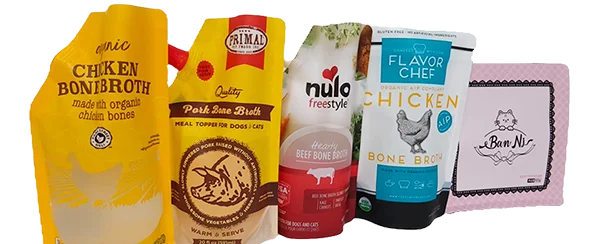
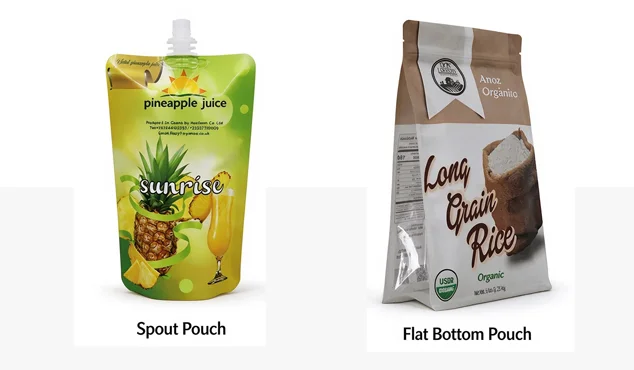
The pouch format sets the manufacturing route, accessory compatibility, and filling-line fit. A flat bottom pouch gives a stable shelf presence and a wide front panel; a stand-up pouch is lighter and more flexible in filling; a spout pouch suits liquids; rollstock may reduce unit cost at high volume but requires the buyer’s filling equipment to handle film.
A practical way to narrow the format is to work backward from fill weight and filling method. Small sachets and sample packs often go to three-side-seal or flat pouches. Medium retail packs commonly use stand-up pouches. Larger pet food and bulk dry goods frequently use flat bottom or side gusset. Liquids and semi-liquids usually point to spout pouches or rollstock with form-fill-seal.
If the format is genuinely undecided, say “recommendation needed” in the RFQ rather than leaving the field blank. A supplier can propose a format, but they need the product and filling context to do it responsibly. The available preformed pouch formats page is a useful reference for naming the format consistently.
Material structure is where many RFQs become ambiguous. “PET/PE” can mean different things depending on layer order, thickness, and whether the PE is a sealant or a structural layer. A clearer notation states the layer sequence from outside to inside, with thickness where known, for example: 12 μm PET/printing/adhesive / 60 μm PE sealant. If the structure is already validated, include the full notation. If only the performance target is known, state the target and mark the structure as “supplier recommendation.”
The three functional roles in a flexible structure are printing substrate, barrier layer, and sealant layer. The printing substrate carries the artwork and provides mechanical strength; the barrier layer limits moisture, oxygen, light, or aroma transmission; the sealant layer makes the pouch closable on the filling line. A structure can combine roles in one film or separate them across multiple layers. For buyers, the practical point is that the sealant layer must be compatible with the filling process, and the barrier layer must match the product’s sensitivity—not simply be “as thick as possible.”
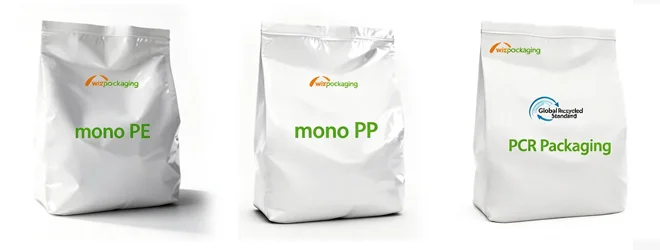
A common mistake is to specify a total thickness without specifying sealant type. Two structures with the same micron count can behave differently on a filling line if one uses a PE sealant and the other uses CPP. If the filling equipment has a known sealing window, share it. If not, ask the supplier to recommend a sealant and confirm the sealing conditions in the quotation. If you are still deciding between mono-material and composite routes, the mono-material and PCR material routes page explains the available directions. The layer checklist for preformed pouches is a helpful cross-check before you write the structure field.
“High barrier” is not a specification. It tells the supplier nothing about which transmission rate matters, at what test condition, or how the pack will be stored. A better RFQ states the product’s sensitivity—moisture, oxygen, light, aroma, or oil—and the shelf-life target, then asks the supplier to propose a structure with supporting data.
For moisture-sensitive products, WVTR is the relevant metric. WVTR is typically reported in g/m²/day, and the test condition matters: a common condition is 38 °C and 90% relative humidity, but buyers should confirm the exact condition on the data sheet rather than assume it. For oxygen-sensitive products, OTR is relevant, often reported in cm³/m²/day/bar, with test conditions such as 23 °C and a defined relative humidity. Light-sensitive products need an opaque or high-opacity layer; aroma-sensitive products need a structure that limits aroma loss and odor ingress, with the seal and zipper reviewed as part of the system rather than as an afterthought.
If the buyer does not have WVTR or OTR targets, the next best input is a shelf-life target and a storage description. The supplier can then propose a structure and state which tests should be run before commercial production. Over-specifying barrier without a shelf-life rationale tends to raise cost without a corresponding benefit. More detail on choosing a barrier target is covered in the barrier properties guide linked from the related reading section.
Seal integrity is not only a quality-control topic; it is a specification input. The RFQ should state the filling method (manual, semi-automatic, automatic premade pouch filler, VFFS, HFFS), the expected product residue in the seal area (powder dust, oil, liquid splash), and any known sealing window. If the buyer has a seal-strength requirement, it should be referenced against a recognized method rather than stated as a feeling.
ASTM F88/F88M is the standard test method for seal strength of flexible barrier materials, and it is used for process validation, capability, and control. Seal strength has both a lower and an upper practical limit: too low risks package integrity, while an unnecessarily high seal strength can make the pack difficult for the end user to open. For that reason, an RFQ that says “seal must be strong” is less useful than one that says “seal strength to be confirmed by ASTM F88, with a target range agreed between buyer and supplier based on the opening experience and filling-line requirements.”
Leak testing and visual seal inspection are separate checks and should be listed as such. A pouch can pass a seal-strength test and still leak through a channel or a contaminated seal area. If the product is liquid or semi-liquid, state whether leak testing is required and whether the supplier is expected to provide test data with the pre-production sample. The seal integrity testing methods guide covers the test side in more detail; this RFQ field only needs to record what the buyer requires.
Pouch dimensions are usually written as width × height + gusset, but a quote without tolerances is incomplete. The supplier needs to know which dimensions are critical for the filling line (for example, the distance from the top seal to the zipper, or the bottom gusset depth) and which can vary within a normal manufacturing range.
If the buyer has an existing pouch, the most efficient approach is to send a physical sample or a dimensioned drawing with tolerances marked. If no reference exists, state the fill weight and the target packed volume, and ask the supplier to propose dimensions with a tolerance table. A pouch that looks correct on a drawing can fail on the filling line if the headspace is too small or the bottom gusset does not open reliably. For a step-by-step approach to sizing, the stand-up pouch size guide is a useful reference before you set the dimension field.
Zippers, sliders, valves, spouts, tear notches, hang holes, windows, and handles all interact with the pouch format and the material structure. A spout that works on a stand-up pouch may not be suitable for a flat bottom pouch without a reinforced spout area. A valve that performs well on a coffee bag may behave differently on a low-density pet food bag if the film stiffness is different.
The RFQ should list each feature and state whether it is required, preferred, or open to recommendation. It should also ask the supplier to confirm accessory lead time and any minimum order implications, because these can affect the total project timeline more than the film itself. If the format is a spout pouch or a flat bottom pouch, reviewing the format-specific pages before finalizing the feature list helps avoid incompatible combinations. For unusual feature requests, the custom pouch capability page shows the accessory scope that can be evaluated.
Quantity affects material purchasing, printing method, tooling amortization, and scheduling. A single number such as “50,000 pouches” is less useful than a quantity range with context: initial order, expected annual volume, number of SKUs, and whether the figure is firm or indicative.
If the project is a first launch, say so. If the buyer expects to scale after a test market, say that too. Suppliers can often propose a sampling plan or a phased production approach when they understand the trajectory, whereas a bare minimum quantity may push the quote toward the highest unit cost unnecessarily.
The RFQ should state the number of colors, the preferred printing method if known, the surface finish expectation (matte, gloss, soft-touch), and the artwork readiness status. If the artwork is not final, say “artwork pending” rather than leaving the field blank; the supplier can still evaluate the structure and quantity.
A practical point: printing method and order quantity are linked. Digital printing can be practical for shorter runs or multiple SKUs, while flexographic and gravure printing may offer advantages at higher volumes for suitable artwork. The RFQ does not need to decide the method, but it should give the supplier enough information to recommend one and explain the trade-off. The printing technology overview is a useful preparation before writing the printing field.
Food-contact declarations, material datasheets, and recycled-content documentation are easier to confirm before the quotation than after the order is placed. The RFQ should state the destination market and the documentation expected: food-contact declaration, GRS or PCR documentation if recycled content is claimed, and any customer-specific compliance requirement.
For agricultural or household products, the relevant documentation may differ from food-contact requirements. Stating the contact category in the product brief allows the supplier to route the inquiry to the right material and compliance review.
MOQ is not a single number; it is the outcome of several cost drivers. The main ones are material purchasing quantity, printing method and tooling, accessory supply, and production scheduling. A digital print run can often start at a lower quantity than a gravure run because there is no cylinder to amortize, while a complex accessory such as a slider zipper or a child-resistant closure may carry its own minimum. When the buyer states the initial order and expected annual volume, the supplier can suggest a practical production plan instead of quoting against a number that does not reflect the project.
Sampling usually moves through three stages. A digital proof confirms artwork, color direction, and text; a physical prototype confirms format, dimensions, and feature placement; a pre-production sample confirms the actual material structure, seal behavior, and print result on the production route. Not every project needs all three, but the RFQ should say which stage the buyer expects to review, because the timeline and cost differ.
Approval before mass production normally follows a fixed sequence: artwork approval, material and structure confirmation, pre-production sample approval, and then production release. Recording these steps in the RFQ prevents the common situation where the artwork is approved but the sealant or the feature set changes later, forcing a second sample round. If the buyer has an internal sign-off process, such as a packaging spec sheet signed by product, quality, and marketing, say so, because it affects how the supplier sequences the approval documents.
The table below is the working template. It can be copied into an email, a spreadsheet, or a shared document and filled field by field.
| Group | Field | What to write | Why it matters |
|---|---|---|---|
| Product | Product form and fill weight | Powder, granule, liquid, piece, frozen, retort; target g or ml | Determines film stress, seal contamination risk, and pouch size logic |
| Product | Contact type and destination market | Food, pet food, cosmetic, agricultural, industrial; EU, US, or other | Routes food-contact or other compliance review |
| Format | Pouch type or rollstock scope | Named format, or “recommendation needed” | Sets manufacturing route and accessory compatibility |
| Dimensions | Width × height + gusset, with tolerances | Dimensions and tolerance table, or a physical sample | Prevents filling-line mismatch |
| Material | Layer sequence and sealant type | Outside-to-inside notation, or performance target marked “open” | Makes quotes comparable and avoids sealant mismatch |
| Barrier | Sensitivity and shelf-life target | Moisture, oxygen, light, aroma, oil; shelf-life in months | Prevents over- or under-specification |
| Seal | Filling method and residue risk | Manual, semi-auto, premade filler, VFFS, HFFS; powder, oil, liquid | Allows sealant and sealing-condition recommendation |
| Features | Zipper, valve, spout, etc. | Required, preferred, or open to recommendation | Affects tooling, lead time, and unit cost |
| Quantity | Initial and annual volume, SKU count | Firm or indicative; first launch or scale-up | Drives printing method and material purchasing |
| Printing | Colors, finish, artwork status | Color count, Pantone, matte/gloss/soft-touch, artwork ready or pending | Allows method recommendation and timeline estimate |
| Compliance | Declaration or certification expected | Food-contact declaration, GRS/PCR documentation, COA | Avoids late-stage documentation gaps |
| Sampling | Expected sample stage | Digital proof, physical prototype, or pre-production sample | Sets timeline and cost expectation |
| Delivery | Destination and required date | Port or door, target arrival, any seasonal constraint | Allows freight and scheduling review |
Mark the format field as “recommendation needed” and give the product form, fill weight, filling method, and quantity. A supplier can propose one or two formats with a short explanation of the trade-off, and the format can be confirmed before sampling.
Yes. A physical sample is often the fastest way to communicate format and dimensions, but it should be accompanied by fill weight, filling method, and quantity context. A sample alone does not tell the supplier how the pack will be filled or how many units are involved.
If the structure is validated and must be repeated, specify it fully. If the structure is open, state the barrier and shelf-life target and ask for a recommendation with supporting data. Marking the field as “open” is better than guessing.
Sealant type and filling method. Many RFQs specify a film thickness but omit how the pouch will be sealed or what residue may be present in the seal area. That gap often delays sampling.
Compare them field by field against the same RFQ: layer sequence, sealant, barrier data, features, printing method, tooling, MOQ, sample stage, and lead time. A lower unit price with an unspecified sealant or a narrower barrier scope is not an apples-to-apples quote.
Before the quotation is finalized. The sample stage determines timeline and cost, and a quote that assumes a digital proof only is not comparable with one that includes a pre-production sample on the production route.
A flexible packaging RFQ is a technical brief, not merely a price request. The details that most impact quote accuracy and sampling lead time include product context, format, material structure or performance targets, seal and filling compatibility, dimension tolerances, special features, order quantity, destination market, and required sample milestones. When these details are clearly provided, suppliers quote against an identical scope, letting buyers compare proposals efficiently without back-and-forth follow-ups for missing information.
It is fine if the format or material selection is still undecided — state open variables explicitly instead of leaving them blank. Knowing which requirements are fixed and which are flexible allows our team to propose workable solutions and highlight items requiring final confirmation prior to production. You can explore more format options and material pathways on our Customized Packaging page and Materials & Sustainability page.
Already holding a spec draft? Submit it for our customized packaging review, and we will audit your document to mark completed fields and flag items requiring technical decisions. If format and material are still to be determined, share your product and filling requirements and request a packaging recommendation. We will outline a practical direction for you before sampling begins.
Chat on WhatsApp
+1 (617) 987-7432