
 English
 Español
 Deutsch
Chat on WhatsApp
+1 (617) 987-7432
You have finalized your product recipe, completed the artwork, and selected the material structure. Now a critical operational question emerges: should you package your product using rollstock film (a roll of printed material that forms a pouch at the moment of filling) or preformed pouches (ready-made bags that arrive already formed)?
This decision is not about which format is “better.” It is about which one fits your actual filling setup, labor skill level, throughput volume, and cost structure. Many brand owners default to preformed pouches because they are familiar, only to discover later that rollstock would have reduced material cost per thousand units and increased units per hour.

This guide compares both formats across six decision-relevant dimensions. By the end, you will have a framework to evaluate which format matches your specific production reality.
The most important distinction between the two formats is the point at which the pouch is formed relative to filling.
| Aspect | Preformed Pouches | Rollstock Film |
|---|---|---|
| When pouch is formed | Before arriving at your facility | During the filling process |
| Your filling action | Open → Fill → Seal | Film forms tube → Bottom seal → Fill → Top seal → Cut |
| Equipment required | Pre-made bag filler (manual, semi-auto, or full-auto) | VFFS machine (vertical form fill seal) |
| Pouch style range | Very wide (stand-up, flat-bottom, spout, side gusset, shaped, back-central sealing, 3-side sealed) | Narrower (pillow, gusseted, quad-seal; stand-up possible with add-ons) |
Understanding this fundamental difference helps explain why the two formats have different profiles in speed, cost, and flexibility. For a visual reference of pouch styles available in preformed format, the preformed pouches overview illustrates the range.
The table below summarizes the key trade-offs. Your decision will depend on which factors weigh most heavily for your specific production volume, product characteristics, and labor environment.
| Decision Factor | Preformed Pouches | Rollstock Film (VFFS) |
|---|---|---|
| Typical filling speed | 15–40 pouches/min (semi-auto) to 60–80 (auto) | 40–120 pouches/min (single lane) |
| Material cost per 1,000 units | Higher – includes forming, handling, individual bag shipping | Lower – typically 15–30% less than preformed |
| Equipment investment | Lower entry cost (manual or semi-auto fillers from <$5,000) | Requires VFFS machine (20,000–20,000–80,000+) |
| Changeover time between SKUs | 5–15 minutes (bag, magazine, and pick-and-place settings) | 15–45 minutes (film roll and forming tube change) |
| Minimum order quantity | Lower (3,000–5,000 pouches typical) | Higher (5,000–10,000 linear meters of film) |
| Storage space for empty packaging | Bulky – empty pouches take significant volume | Compact – one pallet of rollstock equals many pouches |
Instead of asking “which is better,” work through these five questions based on your actual production data.
Question 1: What is your daily or weekly throughput in units?
Under 5,000 pouches/day: Preformed pouches often make sense. The lower equipment entry cost outweighs the higher per-unit material cost.
5,000–15,000 pouches/day: Calculate total landed cost (material + labor + depreciation). Many companies in this range switch to rollstock.
Over 15,000 pouches/day: Rollstock is almost always more economical. The material savings alone justify a VFFS machine.
Question 2: How many different SKUs do you run per week?
1–3 SKUs: Rollstock is ideal. Set up once and run continuously.
4–8 SKUs: Preformed pouches offer quicker changeover. However, standardizing film width on rollstock can reduce changeover time.
9+ SKUs: Preformed pouches typically win, or consider multiple rollstock lines dedicated to high-volume SKUs.
Question 3: What is your available labor skill level?
Rollstock requires an operator who understands heat seal temperatures, film tension, and forming tube setup. Preformed pouches can be filled with lower-skilled labor on semi-automatic equipment. According to labor productivity data published by the Bureau of Labor Statistics (BLS) for packaging operations, facilities with dedicated machine technicians see 35–50% higher effective output from VFFS lines.
Question 4: Do you need complex pouch features like spouts, flat-bottom, or custom shapes?
Yes: Preformed pouches are the primary solution. Spout pouches, flat-bottom (box-bottom) pouches, and shaped pouches cannot be made on standard VFFS.
No (pillow, gusseted, or back-central sealing is fine): Rollstock is a strong candidate.
Question 5: How sensitive is your product to moisture or oxygen during filling?
Rollstock’s continuous motion means the film is open to the environment for less time. For hygroscopic powders or oxygen-sensitive products, rollstock can offer better in-process protection. Preformed pouches sit open waiting to be filled.
To explore how different industries handle this trade-off, the food industries application page provides sector-specific examples.
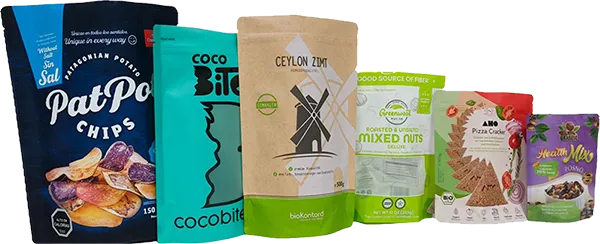
Scenario A: A Pet Treat Brand Launching a Single-SKU Dental Chew
Volume forecast: 60,000 bags/month
Pouch style: Side gusset pouch with zipper
Labor context: Two experienced line operators
Recommendation: Preformed pouches (side gusset with zipper is complex for VFFS)
Reasoning: The zipper and side gusset combination is reliable in preformed format. At this volume, the brand accepts higher material cost in exchange for proven filling reliability.
Scenario B: A Dry Snack Company Producing 200,000 Pillow Bags per Month
Volume: 200,000 pouches/month, single SKU
Pouch style: Pillow bag (no zipper, no gusset)
Labor context: High labor cost region
Recommendation: Rollstock film
Reasoning: Pillow pouch format works perfectly on VFFS. Lower material cost and minimal handling reduce labor expense. The VFFS machine pays for itself within months.
Scenario C: A Tea Brand Offering 15 Blends in Flat-Bottom Pouches with Valves
Volume per SKU: 3,000 pouches/month (45,000 total)
Pouch style: Flat-bottom stand-up pouch with degassing valve
Labor context: Small team, no full-time mechanic
Recommendation: Preformed pouches
Reasoning: Flat-bottom with valve is not feasible on standard VFFS. Frequent changeover (15 SKUs) would make rollstock inefficient. The higher per-unit cost is acceptable for the brand’s premium positioning.
For brands in the pet food sector specifically, the pet food and snack packaging guide offers additional insights on format selection for treats and kibble.
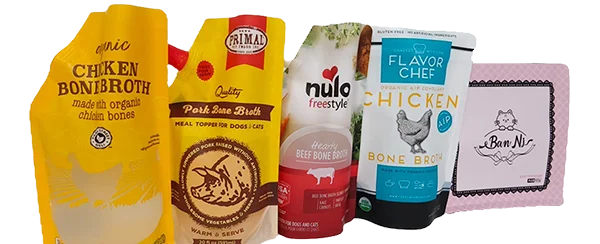
Once you have determined which format aligns with your filling speed and cost model, the next step is translating that decision into a clear technical specification for your packaging supplier.
For preformed pouches, you will need to specify:
Pouch style (stand-up, flat-bottom, side gusset, back-central sealing, 3-side sealed, or shaped)
Opening width (critical for filling spout insertion)
Bottom gusset depth (if applicable)
Accessories (zipper, spout, degassing valve)
Material structure (film layer composition and thickness)
For rollstock film, you will need to specify:
Film width (determined by your VFFS forming tube)
Outer diameter of the roll and core size
Direction of unwind
Heat seal initiation temperature range
Material structure with focus on sealant layer performance
A practical next step is to request material samples from potential suppliers that match your required structure and run them on your actual filling line before committing to full production. To continue building your packaging knowledge base, you may find value in a guide comparing different pouch styles and their compatibility with various filling automation levels.
Chat on WhatsApp
+1 (617) 987-7432