
 English
 Español
 Deutsch
Chat on WhatsApp
+1 (617) 987-7432
A flat bottom pouch — also called a box pouch, block bottom bag, or eight-side-seal pouch — uses a rectangular, box-like base that allows it to stand upright with a structured, premium appearance. The format is widely used for coffee, pet food, snacks, powders, and supplements because it combines the shelf presence of a rigid package with the material and freight advantages of flexible packaging. Selecting the right flat bottom pouch involves matching the base construction and film structure to your product's barrier requirements, choosing appropriate closure features such as zippers or degassing valves, and understanding how the format compares with stand-up pouches in cost and performance.
Flat bottom pouches have moved from a niche premium format to a mainstream flexible packaging choice. Their appeal is easy to understand: they stand on the shelf with a stable, rectangular profile, offer multiple printable panels for branding, and stack more efficiently in cartons and on pallets than stand-up pouches.
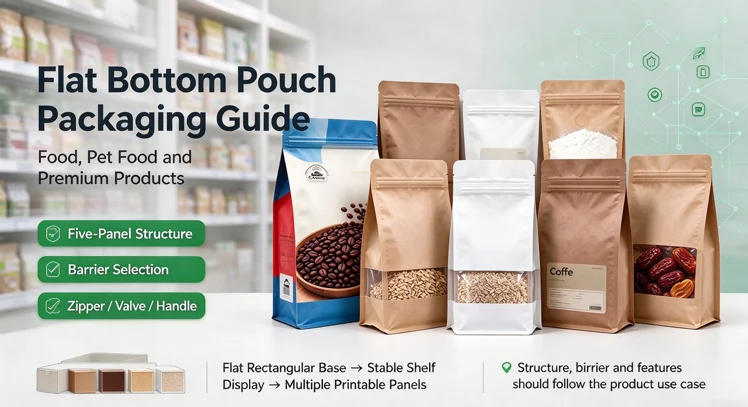
But the format also introduces specification decisions that don't exist with simpler pouch types. The base construction, the film stiffness, the zipper position, and the barrier structure all interact. A flat bottom pouch that performs well for ground coffee may not be suitable for a heavy-fill pet food bag or a moisture-sensitive protein powder.
This guide is written for packaging buyers, product managers, and procurement teams who need to specify flat bottom pouches with confidence. It covers the structural logic of the format, material and barrier selection by product type, functional features, comparison with alternative formats, and a buyer specification checklist.
A flat bottom pouch is a flexible bag with a rectangular, box-like base that allows it to stand upright and hold its shape similar to a carton while retaining the material and weight advantages of a pouch.
The key structural difference from a stand-up pouch lies in the base. A stand-up pouch uses a rounded or gusseted bottom that expands when filled. A flat bottom pouch, by contrast, is formed with a flat, multi-panel base that opens into a stable platform.
A typical flat bottom pouch construction includes:
Five-panel architecture: Front panel, back panel, two side panels, and the bottom base. The five-panel construction creates a relatively rigid rectangular profile after filling and provides multiple printable surfaces.
Side gussets: The side panels fold inward during shipping and expand when the pouch is filled, creating the rectangular silhouette.
Bottom fold and seal: The base is created by folding and sealing panels during pouch conversion. This engineered base is what allows the pouch to stand upright and present a large frontal canvas for branding.
Top seal and opening: The top of the pouch can open fully on all four sides, which enhances filling efficiency and allows the pouch to accept a wider range of filling nozzles.
This structure gives the flat bottom pouch its defining characteristic: the stability of a box with the material efficiency of a pouch. A flat bottom pouch uses far less material and weight than a carton, lowering freight costs, yet presents a similar frontal area for branding.
The flat bottom pouch's primary commercial advantage is shelf presence. The rectangular base and defined side panels create an upscale, structured appearance that differentiates the product from softer stand-up pouches on the shelf.
Three factors drive this:
Larger printable area. The five-panel construction provides front, back, side, and bottom printable surfaces. Brands can use the side panels for product information, story-telling, or regulatory content, while keeping the front panel focused on brand and product imagery.
Stackability and cube efficiency. The rectangular base reduces wasted void space in cartons and on pallets. Retailers and consumers prefer packages that stand sturdy on shelves and in storage.
Shape retention after filling. Unlike a stand-up pouch that can deform when underfilled, a flat bottom pouch maintains its rectangular profile once the base is formed and the pouch is filled. This consistency supports a more controlled retail presentation.
These advantages come at a cost. The flat bottom construction involves more complex folding and sealing steps than a stand-up pouch, which typically makes it more expensive to produce. The format is best suited for products where shelf presence and branding area justify the higher unit cost.
The flat bottom pouch's combination of stability, barrier capability, and printable area makes it suitable for a range of products. The table below summarizes the primary applications and the product-specific considerations for each.
| Product Category | Typical Applications | Key Packaging Consideration |
|---|---|---|
| Coffee | Whole bean, ground coffee, specialty roasts | Aroma and oxygen barrier; one-way degassing valve for freshly roasted coffee; resealable zipper |
| Pet Food | Dry kibble, treats, freeze-dried | Puncture resistance for sharp edges; oil resistance; heavy-fill strength; optional handle for large packs |
| Snacks | Popcorn, chips, nuts, candy | Moisture and oxygen barrier; headspace for fragile products; zipper for reclosure |
| Powders | Protein powder, cocoa, milk powder, supplements | Moisture protection; wide opening for scoop access; strong top seal; opaque structure for light-sensitive ingredients |
| Tea | Loose leaf, tea powder, herbal blends | Aroma retention; light protection; high-barrier structure for sensitive teas |
| Dry Goods | Rice, grains, seeds, pasta | Moisture barrier; puncture resistance for hard edges; cost-effective structure for bulk sizes |
| Non-Food | Detergents, chemicals, cosmetics | Chemical compatibility of sealing layer; leak resistance; durability |
For coffee applications specifically, the flat bottom pouch is often paired with a one-way degassing valve that releases CO₂ from freshly roasted beans while preventing oxygen ingress. The valve position and the roast date must be confirmed before sampling, because the rate and timing of degassing affect valve selection and placement.
For pet food, the primary risks are puncture from sharp treat edges and oil migration that can weaken seals over time. Film thickness and sealing layer selection should be based on the treat hardness, oil content, and filled-bag drop conditions.
The material structure of a flat bottom pouch is typically a multi-layer laminate, with each layer serving a distinct function.
| Layer | Function | Common Materials | What Buyers Should Check |
|---|---|---|---|
| Outer print layer | Print surface, scuff resistance, stiffness | PET, BOPP, paper | Print compatibility; surface finish (matte/gloss) |
| Mechanical layer | Puncture resistance, strength | PET, PA (nylon) | Puncture resistance for sharp products |
| Barrier layer (optional) | Oxygen, moisture, light protection | Metallized PET, aluminum foil, EVOH | OTR/WVTR data for the proposed structure |
| Inner sealant layer | Heat sealing, food contact safety | PE, CPP, PLA | Seal strength; sealing temperature range; food contact compliance |
The barrier layer is selected based on the product's sensitivity profile:
Barrier performance is measured by standard test methods. Two of the most widely referenced are ASTM F1249 for Water Vapor Transmission Rate (WVTR) and ASTM D3985 for Oxygen Transmission Rate (OTR). Buyers should request test data for the proposed material structure rather than relying on total film thickness, because thickness alone is not a reliable indicator of barrier performance.
For applications requiring recyclable structures, mono-material PE or PP options can be evaluated. Recyclable flat bottom pouches made from mono PE or mono PP structures are available, with or without metallization. Their suitability depends on the required barrier performance, seal strength, and local recycling guidance. Review the available material structures and barrier options to understand how layer selection affects packaging performance.
Beyond the base structure and film, flat bottom pouches can be configured with functional features that address specific product and consumer needs.
Resealable zipper. The most common feature for food and pet food applications. Zippers can be positioned at the top of the pouch (top zipper) or integrated into a front pocket (pocket zipper or front zipper) for easy access without opening the full top seal. Zipper position should be confirmed to avoid interfering with the bottom fold or the filling opening.
One-way degassing valve. Essential for freshly roasted coffee. The valve releases CO₂ produced during roasting while blocking oxygen ingress. Valve type and placement should be confirmed based on roast date, filling delay, and whether the product is whole bean or ground.
Laser score / easy-open feature. A laser score creates a controlled opening line for consumers. It can be combined with a zipper for a clean tear-and-reseal experience.
Handle. For large-format pet food bags or bulk products, a handle improves portability. Handle type and placement should be evaluated for load-bearing strength.
Tear notch. A small notch at the top seal to initiate tearing. Often paired with a zipper.
Window. A clear or frosted window can showcase the product. Window material and size should be compatible with the barrier structure.
Each feature adds material cost and production complexity. Features should be specified only where they solve a clear packaging or consumer-use problem, not merely for appearance.
The flat bottom pouch is one of several stand-up flexible formats. The table below summarizes the key differences.
| Consideration | Flat Bottom Pouch | Stand-Up Pouch | Side Gusset Bag |
|---|---|---|---|
| Base structure | Flat, rectangular, box-like base | Rounded or gusseted bottom | No flat base; side gussets expand volume |
| Shelf stability | Excellent; structured rectangular profile | Good; depends on fill volume | Limited; typically lies flat or requires support |
| Printable surfaces | Five panels (front, back, sides, bottom) | Two main panels (front, back) | Front, back, and side gussets |
| Shelf presence | Premium, box-like appearance | Standard retail appearance | Traditional, bulk-oriented |
| Relative cost | Higher due to complex construction | Lower; more economical for small sizes | Moderate; efficient for high-volume |
| Best fit | Premium coffee, pet food, powders, supplements | Snacks, coffee, pet food, general dry goods | Coffee, bulk dry goods, large-format pet food |
The flat bottom pouch offers better shelf stability and a more premium, box-like silhouette than a stand-up pouch. Stand-up pouches are often cheaper to produce and slightly more economical in material weight for small sizes. Side gusset bags offer efficient internal volume for high-capacity applications but lack the flat base of the flat bottom pouch.
For a deeper comparison between flat bottom pouches and stand-up pouches, review the available stand-up pouch specifications and flat bottom pouch details.
Use this checklist when specifying a flat bottom pouch:
Product Requirements
Pouch Structure
Material and Barrier
Functional Features
Printing and Finishing
Quality and Compliance
A flat bottom pouch is a flexible bag with a rectangular, box-like base that allows it to stand upright with a structured profile. It is also called a box pouch, block bottom bag, or eight-side-seal pouch. The format is used for coffee, pet food, snacks, powders, and supplements where shelf presence and stability are important.
The primary difference is the base structure. A flat bottom pouch has a flat, multi-panel rectangular base that provides excellent stability and a box-like appearance. A stand-up pouch relies on a rounded or gusseted bottom to stand. Flat bottom pouches offer better shelf stability and more printable surfaces, but are typically more expensive to produce.
Flat bottom pouches are well suited for coffee, pet food, snacks, powders, supplements, tea, dry goods, and non-food products such as detergents and cosmetics. The format is particularly effective for products where premium shelf presentation and branding area are important.
Yes. Mono-material PE and mono-material PP structures are available for recyclable flat bottom pouches, with or without metallization. The suitability of a recyclable structure depends on the required barrier performance, seal strength, and local recycling guidance.
Common features include resealable zippers (top, pocket, or slider), one-way degassing valves for coffee, laser score or tear notches for easy opening, handles for large formats, and clear or frosted windows. Each feature adds cost and should be specified only where it serves a clear functional need.
Barrier selection starts with the product's sensitivity to moisture, oxygen, light, and aroma. Request OTR and WVTR test data for the proposed structure. For coffee, a high-barrier structure with a degassing valve is typical. For powders, a moisture barrier is critical. For pet treats, puncture resistance and oil resistance are additional considerations.
The flat bottom pouch is a format built around shelf presence and structural stability. Its five-panel construction provides a premium, box-like appearance, multiple printable surfaces, and efficient stacking — advantages that matter for coffee, pet food, powders, and premium snacks.
The most important specification decisions are the base construction and film structure. The base determines how the pouch stands and fills. The film structure determines barrier performance, seal strength, and product protection. Functional features such as zippers and valves should follow from the product's use case, not precede it.
If you are evaluating flat bottom pouches for food, pet food, or premium product applications, review our flat bottom pouch specifications and available options to find formats relevant to your product. For applications demanding specific barrier performance, degassing valves, or recyclable material structures, reach out to our packaging engineering team during the specification stage. Share your project details with us, and we will work with you to select and develop the optimal packaging configuration.
Chat on WhatsApp
+1 (617) 987-7432