
 English
 Español
 Deutsch
Chat on WhatsApp
+1 (617) 987-7432
You have a great product — coffee, snacks, supplements, or pet treats. Now comes the question: what pouch material will keep it fresh, look good on the shelf, and fit your budget?
The material you choose does a lot of heavy lifting. It protects your product, affects how long it stays fresh, and shapes how customers perceive your brand. With so many options available — clear films, white films, metalized films, foil structures, and mono-material alternatives — how do you decide?
This guide breaks down the key factors in pouch material selection, compares the most common options, and helps you match materials to your specific product type. The goal is to give you a practical framework — not a technical deep dive — so you can make informed decisions.
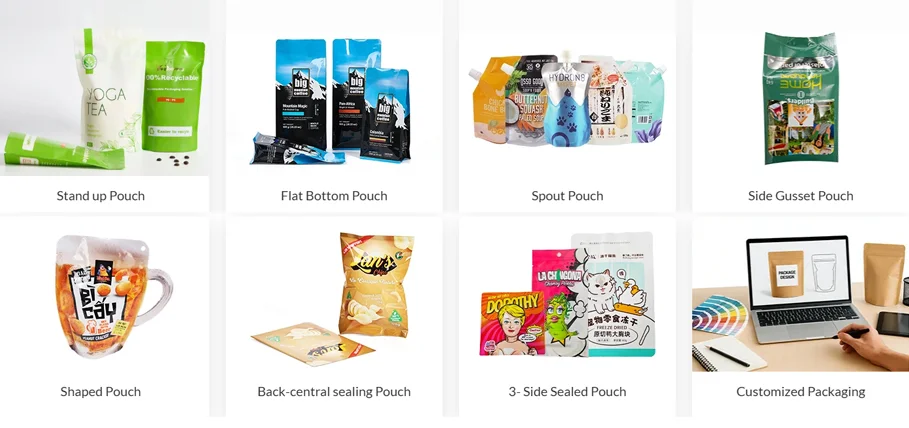
The material you choose for your pouch is not just about wrapping a product — it directly determines freshness, shelf life, brand perception, and even logistics costs. A mismatched material can lead to stale snacks, rancid coffee, leaking liquids, or crushed pet treats, all of which damage brand trust and lead to costly returns.
Moreover, material selection impacts filling line efficiency. Pouches made from incompatible materials may not seal properly on automated equipment, causing downtime and product waste. And with increasing regulations on packaging waste — particularly in the EU — material choices now have compliance implications as well.
In short, getting the material right from the start is one of the most important decisions you will make in your packaging project.
Before you look at specific materials, you need to understand your product and its requirements. Here are the key factors to evaluate.
Start with the product itself. What physical form does it take — solid pieces, powder, liquid, or paste? Is it oily or dry? Does it have sharp edges that could puncture the film? These characteristics determine the mechanical demands on the packaging.
For example, kibble and bone-shaped treats can be abrasive and require puncture-resistant films like PET/NY/PE. Powders need static control and reliable seals to prevent dusting. Liquids and sauces require robust seal strength and leak-proof spouts or fitments.
Barrier requirements are the most critical technical factor in material selection. Consider three types of barrier:
Moisture Barrier (WVTR): Protects against humidity. Critical for powders, snacks, and freeze-dried products.
Oxygen Barrier (OTR): Prevents oxidation, which causes rancidity, flavor loss, and nutrient degradation. Critical for coffee, nuts, and oils.
Light Barrier: Blocks UV light, which can degrade colors, flavors, and nutrients. Critical for supplements, dairy, and light-sensitive products.
High-barrier structures like PET/AL/PE offer maximum protection; metalized films (PET/VMPET/PE) provide excellent barrier at a lower cost; mono-material PE offers limited barrier but improved recyclability.
Mechanical performance affects durability during filling, transport, and consumer handling. Key considerations include:
Puncture Resistance: Essential for sharp or abrasive products like bone-in meat, kibble, or frozen fish portions. Nylon layers (NY/PE or PET/NY/PE) provide excellent puncture resistance.
Tensile Strength: Determines how much stress the film can withstand during filling and handling without stretching or tearing.
Seal Strength: Must be sufficient to hold the product weight and withstand distribution stresses. Minimum seal strength for food-grade pouches typically ranges from 25 N/25mm to 35 N/25mm.
Drop Performance: Pouches must survive drops during filling, handling, and transport. High-performance structures can achieve 100% drop survival rates at 3 meters under frozen conditions.
Your filling method affects material requirements. Manual filling is more forgiving; automated high-speed lines demand consistent film properties, precise seal parameters, and tight dimensional tolerances.
For retort or hot-fill applications, the material must withstand high temperatures (typically 121°C or higher) without delamination or seal failure. For frozen products, the material must maintain seal integrity at -18°C to -30°C without becoming brittle.
Sustainability is increasingly important for brands and consumers. Key considerations include:
Recyclability: Mono-material PE and PP structures are recyclable, while multi-layer laminates with foil are not.
Recycled Content: Options with 30-50% PCR content are available for some structures.
Compostability: Compostable films (PLA-based) are available for specific applications but offer limited barrier performance.
Regulatory Compliance: EU PPWR and similar regulations increasingly favor recyclable, mono-material solutions.
To understand how different material structures balance barrier performance and sustainability goals, review WIZ Packaging's materials and sustainability options.
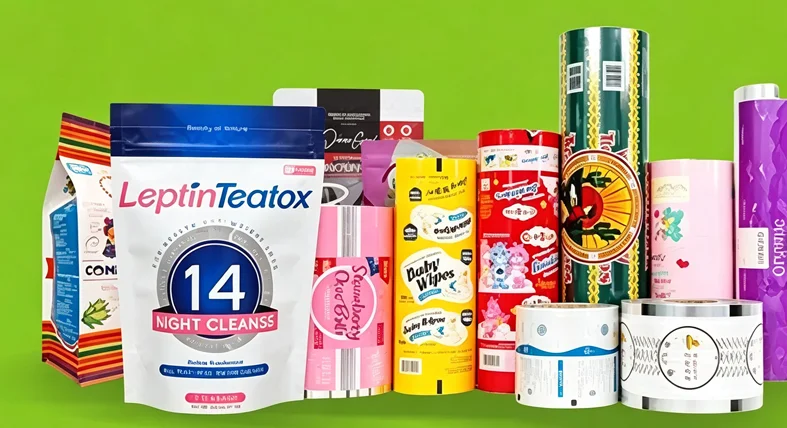
Different product types have distinct packaging needs. Here are practical recommendations for common categories.
This includes crisps, nuts, trail mix, crackers, and baked goods. The primary concern is moisture protection to maintain crispness, plus an oxygen barrier to prevent rancidity in nuts and oils.
Recommended materials: Metalized film (PET/VMPET/PE) for excellent moisture and oxygen barrier with a bright, attention-grabbing appearance. PET/PE for lighter, shorter-shelf-life products.
Key considerations: Stand up pouches are widely used for shelf visibility and branding. Resealable zippers help maintain freshness after opening. Clear windows can be added to showcase the product, but ensure the film's barrier properties are not compromised.
This includes protein powders, baby formula, flour, and instant beverages. The main concerns are moisture protection, dust control, and preventing seal contamination from powder.
Recommended materials: PET/AL/PE for maximum barrier and light protection. Metalized film (PET/VMPET/PE) for good barrier at lower cost. White opaque film for light protection.
Key considerations: Pouches with zippers featuring wipers or shields are effective in preventing powder from contaminating the seal area. Low-static films help reduce dust attraction during filling. Easy-pour spouts or tear notches improve dispensing and consumer convenience.
Kibble, treats, and pet snacks require puncture resistance (for sharp kibble), moisture protection, and often resealability for multi-use feeding.
Recommended materials: PET/NY/PE for puncture resistance and durability. Metalized or foil structures for longer freshness. Mono-material PE for recyclability.
Key considerations: Stand up pouches are the preferred format for retail display. Resealable zippers are critical for convenience and maintaining freshness after opening. Tear notches improve ease of opening for consumers.
This includes soups, sauces, purees, and wet pet food. The main concerns are seal strength to prevent leakage, chemical compatibility with acidic or oily contents, and often heat resistance for retort processing.
Recommended materials: PET/AL/PP or PET/NY/PP for retort applications. PET/AL/PE or PET/NY/PE for non-retort liquids. These structures provide strong seals and chemical resistance.
Key considerations: Spout fitments or corner spouts are commonly used for dispensing. Reinforced seals are essential to prevent leakage. Clear panels may be included for product visibility, but must be carefully engineered to maintain overall barrier performance.
Supplements are sensitive to moisture, oxygen, and light, which can degrade active ingredients. Supplements have some of the most demanding barrier requirements, especially for products containing probiotics, omega-3s, or other sensitive ingredients.
Recommended materials: PET/AL/PE or PET/VMPET/PE for maximum barrier. White opaque film for light protection. Mono-material PE for brands prioritizing sustainability.
Key considerations: Child-resistant zippers may be required for safety compliance. Desiccant packaging options help manage moisture. Clear panels or windows can showcase product quality, but must not compromise the light barrier.
Flexible packaging materials are typically multi-layer structures, with each layer serving a specific function. Here is a breakdown of the most common material families.
Polyethylene (PE) is the most common sealant layer because it seals at lower temperatures and is food-contact compliant. PE-based structures are widely used due to their sealing performance and compatibility with most products. Common PE-based structures include PET/PE, PET/NY/PE, and mono-material PE. PET/PE is a versatile and cost-effective choice for snacks and many dry goods. PET/NY/PE adds puncture resistance for demanding applications like pet food and frozen foods.
Polypropylene (PP) offers better heat resistance than PE, making it essential for retort applications and hot-fill processes. PP-based structures are used where products are filled at high temperatures or require sterilization. Common PP-based structures include PET/AL/PP and PET/NY/PP. These structures withstand retort temperatures up to 121°C.
Polyester (PET) is the most common outer layer because of its printability, strength, and clarity. PET provides a smooth surface for high-quality printing and serves as a structural layer. PET is typically used as the outermost layer in multi-layer structures, providing the surface for branding and the mechanical strength to protect inner layers.
Aluminum foil offers the highest barrier performance against moisture, oxygen, and light. It is often used as a middle barrier layer in premium and long-shelf-life applications. The foil layer is sandwiched between outer and sealant layers. PET/AL/PE and PET/AL/PP are common structures. Foil laminates can achieve OTR values below 0.5 cc/m²/day, extending shelf life significantly.
EVOH (ethylene vinyl alcohol) provides excellent gas barrier properties in a transparent format. This is important for products where visibility is desired, but gas protection is needed. EVOH is typically used as a middle barrier layer in transparent structures like PET/EVOH/PE. These structures offer high oxygen barrier while maintaining clarity, making them suitable for products that need both visibility and protection.
To explore how different pouch styles and material structures meet specific product requirements, review WIZ Packaging's preformed pouch capabilities.
This selection guide helps you quickly match your product type and requirements to the right material direction.
| Product Type | Key Requirement | Material Direction |
| Snacks (crisps, nuts) | Moisture, oxygen barrier | PET/VMPET/PE; PET/PE |
| Coffee, tea | Oxygen, aroma barrier; degassing valve | PET/AL/PE; PET/VMPET/PE |
| Powders (protein, formula) | Moisture, light barrier; static control | PET/AL/PE; PET/VMPET/PE; White opaque |
| Pet food, kibble | Puncture resistance, moisture barrier | PET/NY/PE; PET/VMPET/PE |
| Pet treats (chewy, oily) | Moisture, grease barrier; resealability | PET/NY/PE; PET/VMPET/PE |
| Liquids, sauces (ambient) | Seal strength, leak prevention | PET/AL/PE; PET/NY/PE |
| Liquids, sauces (retort) | Heat resistance, seal integrity | PET/AL/PP; PET/NY/PP |
| Nutritional supplements | Light, oxygen, moisture barrier | PET/AL/PE; PET/VMPET/PE |
| Frozen foods | Puncture resistance, low-temp seal | PET/NY/PE; Mono-material PE |
| Sustainability-focused | Recyclability | Mono-material PE; Mono-material PP |
Sustainability is reshaping the packaging industry. Here are the key developments in sustainable pouch materials.
By engineering an entire pouch from a single polymer family (polyethylene), you eliminate the separation problem that makes multi-layer laminates unrecyclable. Mono-material PE pouches are the most practical recyclability pathway for flexible packaging today. Recent industry collaborations have developed high-performance MDO PE//PE solutions specifically for frozen food packaging.
Key considerations: Barrier performance is lower than foil or metalized structures. Suitable for products with shorter shelf life or where recyclability is prioritized over maximum barrier.
Mono-material PP offers similar recyclability benefits to mono-material PE, but with higher heat resistance. Mono-material PP is suitable for retort and hot-fill applications where PE-based structures may not withstand the processing temperature. It remains a growing option for brands needing both recyclability and heat resistance.
Key considerations: Higher heat resistance than mono-material PE. Suitable for retort applications. Good seal performance on automated lines.
Post-consumer recycled (PCR) content can be incorporated into flexible packaging structures, offering an additional sustainability pathway. Options with 30-50% PCR content are available for some film structures.
Key considerations: PCR content may affect color, clarity, and print quality. Verify performance through testing. Ensure compliance with food-contact regulations in your destination market.
Follow this step-by-step process to make your material selection decision.
Step 1: Define the Product. Start with your product's characteristics — physical form (solid, powder, liquid, paste), moisture and fat content, pH level, any special requirements (e.g., oxygen-sensitive, light-sensitive).
Step 2: Define Shelf Life. What is your target shelf life? Three months, six months, or 24 months? Longer shelf lives demand higher barrier performance and more robust structures.
Step 3: Define Distribution Conditions. Where and how will your product be distributed? Temperature variations, altitude changes, stacking pressure, and transport duration all affect material requirements. If your product is shipped by air or over long distances, higher barrier and seal strength may be needed.
Step 4: Balance Performance and Sustainability. Evaluate the trade-offs between barrier performance and sustainability. Determine if recyclability is a priority for your brand, and if so, whether mono-material options can meet your performance needs.
Step 5: Validate Through Samples. The final step is to request samples of your actual material structure and test with your actual product. Conduct shelf-life testing, seal integrity testing, and drop testing. Approve a physical sample before committing to mass production.
For more guidance on quality validation and defect prevention, see our related guide on common flexible packaging defects.
WIZ Packaging provides comprehensive support across the material selection and production process:
Materials: A wide range of structures including PET/PE, PET/NY/PE, PET/AL/PE, PET/VMPET/PE, and mono-material PE. Material selection is based on your product requirements and sustainability goals.
Lamination: In-house lamination with both dry and solvent-free processes, ensuring consistent bonding across all structures.
Printing: Gravure, flexo, and digital printing options with up to 10 colors, plus finishing options like matte, gloss, spot UV, and hot stamping.
Prototyping: 3D modeling and physical prototyping services to test form, fit, and function before production.
Quality Control: End-to-end digital quality control from raw material receiving (IQC) to finished product shipment (OQC), with documented test results available.
PET/PE is the most common general-purpose structure. It offers good barrier, printability, and sealability at a reasonable cost.
Choose aluminum foil when you need the absolute highest barrier against moisture, oxygen, and light. Foil is ideal for long shelf life (18+ months) and products like premium coffee and supplements. Choose metalized film for excellent barrier at a lower cost, suitable for most snacks, coffee, and mid-shelf-life products.
A mono-material pouch is made from a single polymer family (e.g., all-PE or all-PP). This structure is designed for recyclability, as there is no need to separate different materials. It matters because it offers a practical pathway to circular packaging.
Products sensitive to moisture (powders, freeze-dried foods), oxygen (oils, nuts, coffee), or light (supplements, dairy) need high barrier. If your product has a shelf life target of 12+ months, high barrier is typically required.
Mono-material PE offers lower barrier than foil structures. It is suitable for shorter shelf life products. For products demanding maximum barrier and long shelf life, traditional multi-layer laminates (with foil or metalized layers) remain the most effective solution for now.
Choosing the right pouch material is about understanding your product's needs and balancing them against your sustainability goals and budget. Start with product requirements, then consider shelf life, distribution conditions, and regulatory compliance. Test your choices with physical samples before committing to mass production.
Examine varied requirements and use‑cases across different industries, including packaging bag formats, material constructions, barrier performance, and sustainability. Explore WIZ Packaging’s material and sustainability solutions.
1. How to Evaluate Pouch Packaging Quality Before Ordering
2. Stand Up Pouches for Pet Treats: Resealable Options & Freshness Protection
3. Gravure vs Digital Printing: Which One Delivers Better Quality for Your Product?
4. Understanding Color Deviations When Changing Packaging Stock & Surface Treatments
5. Seal Integrity Testing: Key Tips for Food & Pet Food Brands
Chat on WhatsApp
+1 (617) 987-7432