
 English
 Español
 Deutsch
Chat on WhatsApp
+1 (617) 987-7432
You’ve received a material specification from a pouch supplier. It reads something like “PET / MET-PET / LLDPE, 100 µm.” You nod. It looks professional. But do you actually know which layer is responsible for keeping your product fresh, which one determines whether your pouch will survive shipping, and which one decides whether the print on the front panel will still look sharp after six months on a retail shelf?
Most buyers focus on the headline material acronyms and miss the five interdependent layers that determine whether a stand-up pouch performs or fails. This guide breaks down the five layers you need to verify before approving any preformed pouch specification—and translates each technical parameter into what it means for your product, your shelf life, and your production line.
If you’re at the stage of comparing pouch formats before diving into layer-level specifications, reviewing the range of stand-up pouch styles and structural options can help you frame the decision at the right level.
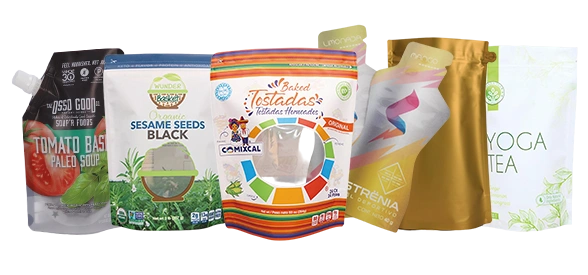
The outer layer is the first thing a consumer sees, touches, and judges. But its job is not just aesthetic. The outer substrate determines print quality, surface durability, and—critically—how the pouch behaves under tension on a high-speed filling line.
Two dominant choices, two different failure profiles:
| Outer Substrate | Typical Thickness | Key Strength | Key Weakness | Best For |
|---|---|---|---|---|
| BOPET (biaxially oriented PET) | 12 µm | Print quality, tensile strength (180–220 MPa per ASTM D882), dimensional stability | Lower puncture resistance than nylon | Dry snacks, coffee, most retail pouches |
| BOPA (biaxially oriented nylon) | 15–20 µm | Puncture resistance (Elmendorf tear 30–40% higher than BOPET), flex crack resistance | Moisture-sensitive; register drift above 70% RH | Products with sharp edges (dried pasta, bone-in jerky, whole nuts) |
The practical question: Does your product have edges or corners that could puncture the film during filling, shipping, or handling? If yes, BOPA is worth the trade-off in moisture sensitivity. If not, BOPET delivers better print sharpness and web stability at high filling speeds.
A common blind spot: BOPP outer layers (30 µm) appear in low-cost snack applications, but their surface gloss and print resolution ceiling make them unsuitable for premium retail positioning. If your brand depends on shelf presence, the outer layer is not where you cut corners.
This is the layer that costs the most money—and the layer most often over-specified or under-specified. The barrier layer controls oxygen transmission rate (OTR) and water vapor transmission rate (WVTR), the two metrics that determine how quickly your product degrades.
The barrier hierarchy (and what each level actually costs you):
| Barrier Structure | Typical OTR (cc/m²/day) | Typical WVTR (g/m²/day) | Relative Material Cost | Best For |
|---|---|---|---|---|
| No barrier (PE only) | 30–50 | 8–15 | Baseline | Short shelf life (under 3 months), non-sensitive products |
| Metallized PET (MET-PET) | 1–5 | 1–4 | +20–30% vs. no barrier | 9–12 month shelf life, dry snacks, coffee |
| EVOH co-extruded | 0.5–3 | 5–8 | +30–50% | Oxygen-sensitive, moderate moisture barrier needs |
| Aluminum foil | <0.1 | <0.01 | +35–45% vs. standard PET/PE | 18+ month shelf life, retort, pharmaceuticals, highly sensitive products |
For a dry snack with a 9–12 month shelf life target, the industry benchmark is OTR ≤ 5 cc/m²/day and WVTR ≤ 2 g/m²/day—a specification that metallized PET typically meets at 20–30% lower cost than aluminum foil. Foil becomes justified when the product is genuinely oxygen- or moisture-sensitive enough to require barrier levels below 0.1 cc/m²/day.
What this means for your decision: If a supplier proposes foil for a product with a 9-month shelf life, ask why. If they propose PE-only for a product with a 12-month target, ask for OTR and WVTR test data on the actual laminate—not the individual film layers, because lamination and adhesive layers change the final barrier performance.
The GB/T 40266-2021 standard for oxide-barrier transparent plastic laminates specifies test items including WVTR, OTR, tensile strength, peel strength, and heat seal strength—the exact parameters you should request from any pouch supplier as part of the material specification dossier. ASTM D3985 and ASTM F1249 are the internationally recognized test methods for OTR and WVTR, respectively.
The sealant layer is the innermost film—the one that faces the product and seals to itself under heat and pressure. It is the layer most directly responsible for package integrity, and it is where the majority of field failures originate.
The industry standard for dry and semi-dry food pouches is LLDPE at 50–80 µm thickness. For heavier fills (50g–2000g), sealant thickness typically increases to 50–200 µm to provide adequate seal strength and burst resistance.
Three sealant properties to verify before approving a specification:
Seal strength: Measured per ASTM F88, this determines how much force is needed to peel the seal apart. For a 3-sided pouch with LLDPE sealant, typical target seal strength ranges from 30–50 N/15mm. Lower values risk leaks during distribution; excessively high values can cause seal creep or make the pouch difficult to open.
Hot tack: This measures how quickly the sealant develops strength while still hot—critical for high-speed filling lines where the seal is stressed immediately after forming. Poor hot tack causes seal failures that only appear after the pouch has left the filling station.
Contamination tolerance: If your product contains powders, oils, or fine particles, the sealant layer must be able to form a reliable seal even when trace product contaminates the seal zone. LLDPE offers moderate contamination tolerance; specialty sealants (such as metallocene-based grades) offer better performance at higher material cost.
A common specification mistake: Approving a sealant layer based on thickness alone without verifying seal strength and hot tack data. A 70 µm LLDPE layer from one supplier may deliver 25 N/15mm seal strength, while the same thickness from another delivers 45 N/15mm—depending on polymer grade, additives, and extrusion conditions. The thickness tells you nothing about seal performance.
Adhesive layers are typically 2.5–5 µm thick—too thin to see in a cross-section photograph, but thick enough to cause delamination when applied below specification.
Delamination is the most diagnostic quality failure in flexible packaging. Unlike a seal leak (which may have multiple causes), delamination almost always traces back to one of two root causes: adhesive coat weight below specification, or insufficient curing time before slitting and conversion.
The industry benchmark for adhesive coat weight in dry-bond lamination is typically 2.5–4.0 g/m², depending on the adhesive system and substrate combination. When coat weight falls below 2.5 g/m², the bond between layers weakens, and the pouch may develop cloudy patches, stripe-like ridges, or visible layer separation after flexing or during distribution.
What you can verify without a laboratory:
Request a T-peel test report (ASTM D1876) for the actual laminate structure being proposed. Peel strength should typically exceed 2.5 N/15mm for dry-bond laminates; values below 2.0 N/15mm indicate a weak bond.
Ask about adhesive cure time and storage conditions before slitting. Insufficient curing is a process control issue, not a material issue, but it produces the same delamination failure mode.
For retort or high-temperature applications, verify that the adhesive system is rated for the sterilization temperature—standard adhesives may fail at 121°C retort conditions.
The total thickness of the laminate—typically expressed in microns—is not simply the sum of individual layer thicknesses. It determines the pouch’s stiffness, stand-up stability, puncture resistance, and how it behaves on your filling machine.
Typical total caliper ranges for preformed stand-up pouches:
| Application | Typical Total Caliper | Key Balance Point |
|---|---|---|
| Small sachets (under 30g) | 60–80 µm | Flexibility for high-speed filling |
| Standard retail pouches (100–500g) | 90–120 µm | Balance of stiffness and print quality |
| Large format / bulk (1–5 kg) | 120–180 µm | Stiffness for stand-up stability, burst strength |
| Retort / heavy-duty | 150–200+ µm | Heat resistance, seal integrity under pressure |
A common misconception: thicker is not always better. A pouch that is too stiff may not form cleanly on the filling line, causing misalignment and seal failures. A pouch that is too thin may not stand upright on the shelf after partial product removal. The right caliper is the one that matches your product weight, filling method, and retail display requirements.
The structure balance checklist:
Does the total caliper match your product weight and filling method? (Gravity filling vs. auger filling vs. liquid filling impose different stresses on the pouch.)
Is the outer layer thick enough to protect the print during handling and shipping?
Is the sealant thick enough to provide reliable seals at your line speed and seal temperature?
Does the barrier layer actually deliver the OTR and WVTR values your product requires, tested on the finished laminate?
Scenario A: Premium Coffee (12oz Whole Bean, 12-Month Shelf Life)
Product threat: Oxygen (staling), moisture (loss of aroma), and light.
Critical layers: Barrier layer (MET-PET at OTR 1–3 cc/m²/day), sealant layer (LLDPE 60–70 µm with degassing valve compatibility), outer layer (BOPET 12 µm for print quality).
What to verify: Degassing valve seal integrity, WVTR ≤ 2 g/m²/day, seal strength ≥ 35 N/15mm.
Layer decision most often wrong: Using a standard LLDPE sealant that does not maintain seal integrity when the valve is inserted—valve-equipped pouches require a sealant layer with specific hot tack and flow properties.
Scenario B: Dried Fruit Mix with Sharp Nut Pieces (200g, 9-Month Shelf Life)
Product threat: Puncture from sharp edges, moisture ingress (texture loss), oxygen (rancidity of nuts).
Critical layers: Outer layer (BOPA 15 µm for puncture resistance instead of BOPET), barrier layer (MET-PET for 9-month OTR target), sealant layer (LLDPE 70–80 µm for seal strength over irregular product).
What to verify: Puncture resistance of the outer substrate, seal integrity over product-contaminated seal zones, T-peel strength ≥ 3.0 N/15mm.
Layer decision most often wrong: Specifying BOPET as the outer layer because it prints better, then discovering puncture failures during distribution.
To see how these layer-level decisions play out across different product categories, browse WIZ Packaging’s industry-specific packaging solutions for snacks, coffee, pet food, and nutritional products.
.webp)
By now, you should have a clearer picture of the five layers that determine whether a preformed stand-up pouch performs as specified. The verification sequence for your next pouch project:
Define the primary product threat: Moisture, oxygen, light, puncture, or grease? This determines which layer does the most work.
Specify OTR and WVTR targets based on your actual shelf life target—not on “what other suppliers use.”
Verify sealant layer performance with seal strength and hot tack data, not thickness alone.
Request T-peel and coat weight data for the adhesive system, especially for retort or high-humidity applications.
Confirm total caliper against your filling method and product weight—stiffness and stand-up stability are functional requirements, not cosmetic preferences.
Once you have clarified these layer-level requirements, comparing the specific material structures available from different suppliers becomes the next logical step. You can review WIZ Packaging’s stand-up pouch capabilities for retail-ready formats with verified layer specifications, or explore materials and sustainability options for recyclable and mono-material structures that maintain barrier performance.
Mono-Material vs Multi-Layer Film: Recyclability and Waste Trade-Offs
Stand-Up Pouch Seal Strength: What N/15mm Values Actually Mean for Your Product
Chat on WhatsApp
+1 (617) 987-7432