
 English
 Español
 Deutsch
Chat on WhatsApp
+1 (617) 987-7432
Barrier performance is the ability of a finished pack, not just its film, to limit moisture, oxygen, light and aroma transfer between the product and the outside environment. WVTR and OTR quantify two of those flows under defined test conditions. The seal, the closure, the headspace and the pack's surface-to-volume ratio decide what the number means once the product is inside it.
Most barrier disputes come from three gaps: a target written without a test condition, a structure approved on film data alone, and a shelf-life claim made before anyone ran a pack test. This guide closes those gaps for each barrier dimension and shows how to write a requirement a supplier can quote against and a buyer can verify.
A barrier specification written from a material list usually fails in one of four ways, and each one leaves a different fingerprint. Reading the fingerprint first is faster than arguing about structures.
A dry product that goes soft, clumps or loses crunch is gaining moisture. The metric is WVTR, and the leak is often not the film at all but the seal channel, the zipper or a pinhole created during filling.
A product that turns rancid, loses colour or drops its vitamin claim is absorbing oxygen. The metric is OTR, but the oxygen already trapped in the headspace usually matters more in the first weeks than the oxygen arriving through the film.
A dairy, oil or supplement product that develops off-notes under retail lighting has a light problem, which is not expressed as a transmission rate in the same way as WVTR and OTR. Light protection is a property of opacity and of the wavelengths blocked, and a clear high-barrier film does not solve it.
A coffee, tea, spice or pet food product that loses its smell before it loses its freshness has an aroma problem. Aroma retention tracks oxygen barrier loosely but not exactly, and the closure is part of the system: a foil structure behind a leaking valve still leaks.
| What the buyer observes | Mechanism | Metric to specify | Where it usually fails |
|---|---|---|---|
| Softening, caking, loss of crispness | Moisture ingress | WVTR, g/m2/day at a stated temperature and RH | Seal channels, zipper, filling damage |
| Rancidity, colour shift, vitamin loss | Oxygen ingress | OTR, cm3/m2/day/bar at a stated condition | Headspace air, poor flush, film OTR |
| Fading, off-flavour under retail light | Light transmission | Opacity or light transmission of the structure | Clear film chosen for shelf appeal |
| Aroma fade, odour ingress | Volatile transfer | Aroma barrier, often read alongside OTR | Closure, valve, seal, film aroma retention |
| Seal weakening, oil staining | Oil migration | Sealant compatibility, seal strength after contact | Sealant layer choice, oil on seal area |
The useful way to set a target is to translate the product's tolerance into a transmission budget, then choose a barrier class. The table below gives the class most projects start from. Treat the bands as working ranges for a specification conversation, not as validated shelf-life data: two products in the same category can need different targets because their fill weight, pack size and distribution differ.
| Product group | Dominant risk | Starting WVTR class | Starting OTR class | Light | Structure direction to evaluate |
|---|---|---|---|---|---|
| Dry biscuits, crackers, cereal | Moisture gain | Very high, under 0.5 | Medium, above 10 | Not critical | Metallized PET or AlOx PET with PE sealant |
| Coffee, ground and whole bean | Oxygen and aroma | High, 0.5 to 2 | Very high, under 1 | High | Foil or high-barrier metallized with valve |
| Tea, including bags in pouches | Aroma and moisture | High, 0.5 to 2 | High, 1 to 5 | High | Metallized or foil, low-odour sealant |
| Nuts and fried snacks | Oxygen and oil | High, 0.5 to 2 | High, 1 to 5 | Medium | Metallized with oil-resistant sealant |
| Milk powder, infant formula | Moisture and oxygen | Very high, under 0.5 | High, 1 to 5 | Medium | Foil or high-barrier composite, nitrogen flush |
| Pet food and treats | Aroma and rancidity | High, 0.5 to 2 | High, 1 to 5 | Low to medium | Metallized or high-barrier mono where recyclable |
| Nutritional supplements | Moisture, oxygen, light | Very high, under 0.5 | High, 1 to 5 | High | Opaque or foil, small pack sizes |
| Retort and hot-fill | Seal and structure integrity | Structural, not film-limited | Structural | Medium | Retort-grade CPP or foil, tested after retort |
| Frozen food | Moisture and ice crystal | Medium, 2 to 10 | Medium, above 10 | Low | Low-temperature sealant, anti-fog options |
Two adjustments are worth making before the numbers are fixed. Small packs fail faster than large ones at the same film specification, because the surface area to volume ratio is higher: a 50 g sachet can lose the same percentage of quality in a fraction of the time a 1 kg bag takes. And a target copied from a temperate distribution chain will under-protect a product that spends weeks in a hot, humid warehouse.
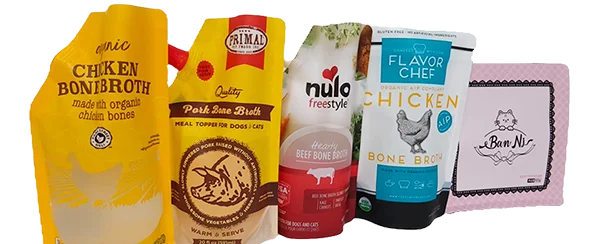
Category also changes the failure mode, not just the number. Coffee and tea packs usually fail through the valve and the headspace before the film becomes the limit, which is why the drink and tea packaging notes treat closure and flush as part of the barrier discussion. Pet food and treats behave differently again: aroma retention and fat migration matter more than crispness, and the pet food and treat applications set out the formats that carry those requirements.
Every barrier structure has a ceiling, and the ceiling is usually a specific physical behaviour rather than a cost limit. Knowing the behaviour prevents the most expensive mistake in packaging: paying for barrier the product cannot use, or trusting barrier the structure cannot hold.
| Option | Moisture | Oxygen | Light | Recyclability position | Typical failure mode |
|---|---|---|---|---|---|
| PET/aluminium foil / PE | Very high | Very high | Full | Not mono-material recyclable in most streams | Pinholes and flex cracks in foil; higher weight |
| Metallized PET / PE | High | High | Partial | Depends on substrate and layer thinness | Metallized layer cracks under flex or filling stress |
| AlOx-coated PET | High | High | None to low | Better than metallized in some streams | Coating damage at seals and folds |
| PE / EVOH / PE | High | Very high when dry | None | Mono-PE route possible with EVOH content limits | EVOH barrier collapses at high humidity |
| MDO-PE based mono-PE | Medium to high | Medium to high | None | Mono-PE recyclable | Lower barrier ceiling; needs thickness and print discipline |
| BOPP-based mono-PP | Medium | Medium | None | Mono-PP recyclable | Limited high-barrier ceiling; seal window narrower |
| Paper-based laminate | Low to medium | Depends on coating | Low | Paper stream claim needs verification | Moisture creeps through the paper edge and fold |
| Nylon-based composite | Medium | High | None | Usually multi-material | Humidity sensitivity; curl and dimensional change |
The practical rule: a structure is chosen by its weakest functional layer, not its best headline number. A foil structure with a contaminated seal is a leaking pack. A metallized structure that cracks at the gusset is a medium-barrier pack in the field even if the data sheet says high.
Where a market or a brand commitment requires a mono-material design, the mono-material PE and PP routes we run are the relevant starting point, and the ceiling of each route should be confirmed against the product tolerance before print is commissioned.

Buyers often ask for a heavier film when a shelf-life test fails, and the request usually misses the physics. Moisture and oxygen transmission are governed by the barrier layer, not by the total calliper. Adding 20 microns of PE adds mechanical strength and seal robustness, and adds cost, but it moves OTR very little.
Three mechanisms explain most of the confusion.
EVOH is an excellent oxygen barrier when dry and a much weaker one when it absorbs moisture. In a high-humidity pack, the EVOH layer's performance depends on how well the adjacent layers keep moisture away from it. That is why the same EVOH percentage can behave differently in a retort pack and a dry-goods pouch.
Metallized layers are thin aluminium deposits. They deliver a good barrier per gram, but they crack when the film is flexed, when the pouch is filled roughly, or when the laminate is folded sharply at the gusset or the seal shoulder. Barrier loss after flexing does not appear on the incoming data sheet; it appears in the market.
Foil is close to absolute until it has a pinhole. A single pinhole through a 9-micron foil can dominate the transmission of the whole pack, which is why foil structures need seal and handling discipline more than they need extra thickness.
The corollary for specification work: state the barrier requirement as a performance target for the finished pack, and let the supplier choose the structure. Specifying "PE 120 micron" tells the supplier what to buy and tells the buyer nothing about protection.
Converting a data sheet into a shelf-life expectation is arithmetic, not opinion. The two quantities that matter are the total transmission over the target period and the amount of change the product can absorb.
Oxygen ingress over the shelf life equals OTR multiplied by the exposed film area and the number of days. Moisture gain follows the same shape with WVTR. The tolerance side comes from the product: how much oxygen uptake or moisture gain changes the sensory or analytical result.
An illustrative calculation, using round numbers to show the method rather than to predict a result: a 250 g coffee pack with 1,200 cm2 of film area, at an OTR of 1.0 cm3/m2/day, admits about 0.12 cm3 per day, or roughly 44 cm3 over a year, before headspace and seal leakage are counted. Change the area to a 50 g sachet at the same film specification and the ingress per gram of product rises sharply, which is why small packs often need the higher barrier class.
The number that usually decides the outcome is not the film at all. Residual oxygen left in the headspace after filling can exceed a year of film ingress within the first week. Nitrogen flushing, vacuum, oxygen absorbers and tighter headspace control act on that side of the balance, and no film can compensate for a pack sealed with a large pocket of air.
A barrier number without its test condition is not a specification, and a supplier certificate without a method is not evidence. Six items make a data sheet usable, and a buyer can ask for all six in one email.
The test method, named by standard rather than described loosely. WVTR is commonly reported to ASTM F1249 and OTR to ASTM D3985; seal strength is tested to ASTM F88. A report that names no method cannot be compared with another supplier's.
The test condition, including temperature and relative humidity on both sides of the specimen. A WVTR at 38 C and 90 percent RH is not interchangeable with a WVTR at 23 C and 50 percent RH, and mixing the two in a comparison is a common source of wrong decisions.
The specimen preparation, including whether the sample was taken from flat film or from a finished pouch, and whether it was flexed before testing. Finished-pack testing is closer to the truth and is the only version that captures seal and gusset effects.
The units and the normalisation basis, so that g/m2/day and cm3/m2/day/bar are not silently mixed with per-pack figures.
The laboratory and its accreditation, because a third-party report from an accredited lab carries different weight than an internal screening result, especially when a customer or regulator asks for documentation.
The date and the structure version, because barrier data belongs to a specific laminate, not to a product family.
When a supplier cannot provide a finished-pack test, the practical route is a pilot: fill the actual product, seal under production conditions, store at the intended condition, and test at intervals. Accelerated storage shortens the wait, but the correlation to real-time behaviour should be understood before a shelf-life claim is published.
Barrier cost is not linear, and the expensive steps are usually the ones that buy the least additional protection. The table uses a relative index rather than prices, because absolute cost depends on order quantity, print coverage and freight lane.
| Barrier level | Typical structure direction | Relative material and conversion index | Best fit | Where the money is wasted |
|---|---|---|---|---|
| Base | Mono-PE or mono-PP, no functional layer | 1.0 | Short shelf life, low sensitivity | Over-specified for a fast-turning product |
| Medium | Metallized PET or coated film in a laminate | 1.2 to 1.5 | Dry goods, snacks, pet treats | Flex cracking eats the gain |
| High | EVOH or AlOx in a tuned laminate | 1.4 to 1.8 | Coffee, tea, supplements | EVOH at high humidity, coating damage at folds |
| Very high | Foil-containing laminate | 1.8 to 2.4 | Long shelf life, aroma-critical, medical-adjacent | Pinholes; paying for foil then packing roughly |
| Recyclable high | Mono-PE with high-barrier tuning | 1.3 to 1.9 | Markets with design requirements | Chasing a barrier the mono route cannot hold |
The decision rule that survives contact with production: spend on barrier until the product's tolerance is covered with margin, then spend the next increment on seal consistency and headspace control. A medium-barrier structure with a reliable seal routinely outperforms a high-barrier structure with a variable one.
A barrier requirement is complete when a supplier can quote against it without asking a question, and a buyer can reject a delivery against it without an argument. The format belongs in that requirement too, because gusset geometry and seal layout set where the structure is stressed; the preformed pouch formats we produce show the seal and gusset configurations that a barrier target has to survive.
The failures that repeat across categories are less technical than they look. A high-barrier film paired with a leaking valve. A foil laminate damaged at the gusset by a filling nozzle. An EVOH structure specified for a humid pack without a moisture-resistant adjacent layer. A metallized structure approved on flat-film data and then flexed in a vertical form fill seal machine. A target written as "high barrier" with no number, which leaves the supplier to guess and the buyer unable to reject.
Is WVTR or OTR more important for a dry powder?
WVTR usually leads, because moisture drives caking and flowability. OTR still matters if the powder contains oxidation-sensitive actives or added fats. Specify both when the product has both sensitivities, and state the pack size, because small sachets see higher transmission per gram.
Can a mono-PE structure reach a high barrier?
It can reach a useful one. Mono-PE with EVOH or AlOx can meet many dry-goods and pet food targets, but the ceiling is lower than foil, and EVOH performance depends on humidity control inside the pack. Test the finished pack against the actual target rather than a general high-barrier claim.
Why does our barrier test pass but the market complains?
Because the film test and the pack are different objects. Seal channels, flexed metallized layers, damaged foil at folds and residual headspace oxygen are all invisible to a flat-film test. Move verification to filled packs sampled from production.
How long should a shelf-life test run?
Long enough to cover the claim with margin, at the storage condition the product will actually see. Accelerated conditions give an early signal, but the acceleration factor should be justified for the product, and a real-time check should run in parallel for the first launch.
Does a heavier film improve barrier?
Rarely in proportion to cost. Transmission is dominated by the functional layer; extra sealant thickness improves mechanical robustness and seal reliability, which is a different and often worthwhile benefit.
What should we send a supplier to get a comparable quote?
The product and its sensitivity, fill weight and pack format, the shelf-life target and distribution conditions, the barrier targets with methods and conditions, the closure and any filling constraints, and the market's material requirements. That set removes most of the back-and-forth in a first quote.
Barrier performance is a system property of the finished pack, and the specification should be written that way: name the dimension, give the target with a method and a condition, define the pack size and the headspace treatment, treat the closure as part of the barrier, and verify on filled packs rather than flat film.
The cost logic follows from the same idea. Buy barrier up to the product's tolerance, then buy consistency. Most shelf-life failures that reach the market are not caused by choosing too little barrier; they are caused by a structure that was right on paper and inconsistent in production.
If the brief is still at the stage of "we need high barrier", the productive next step is to write the four numbers: shelf-life target, pack size, storage condition, and allowable quality change. Once those exist, a structure review becomes a technical conversation instead of a price conversation, and the technical team can review those four numbers against the structures currently available.
Chat on WhatsApp
+1 (617) 987-7432