
 English
 Español
 Deutsch
Chat on WhatsApp
+1 (617) 987-7432
You have developed a frozen food product — vegetables, ready meals, seafood, or pet food — that delivers on taste, texture, and nutrition. Now comes the critical question: how will you package it to survive the freezer?
The frozen aisle presents one of the most rigorous environments for any package. Unlike ambient or chilled categories, frozen food packaging must withstand subzero temperatures, repeated freeze-thaw cycles, and abrasion from sharp ice crystals — all without compromising seal integrity or appearance. Most flexible films perform well at ambient temperatures; at -18°C and below, the same materials behave very differently, and that difference is where frozen food packaging problems tend to start.
According to Future Market Insights, the global flexible frozen food packaging market is projected to grow from USD 27.4 billion in 2025 to approximately USD 40.2 billion by 2035, reflecting a CAGR of 4.9%. By packaging type, bags and pouches led with a 34.98% revenue share in 2025. This growth reflects both rising consumer demand for frozen convenience foods and the increasing complexity of packaging requirements.
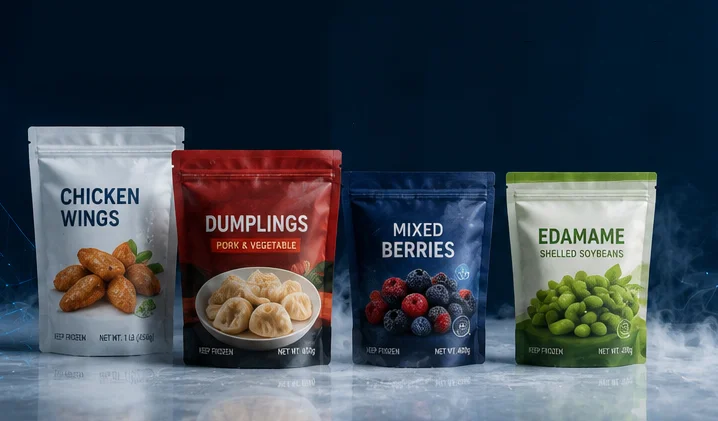
For an overview of available pouch formats suitable for frozen applications, review WIZ Packaging's preformed pouch collection.
This guide walks you through the key considerations for choosing preformed pouches for frozen foods: material selection, barrier requirements, seal integrity, pouch styles, and what to look for in a packaging partner.
Frozen environments demand specific material properties that many standard packaging solutions cannot deliver. Packaging must resist cold-crack — the tendency of certain plastics to become brittle at freezing temperatures. It must also maintain strong moisture barrier integrity to prevent freezer burn, and hold seal strength through thermal cycling.
A quality freezer-grade pouch will hold up at -18°C (0°F) without cracking, leaking, or losing its seal. When a film fails — through brittleness, cracked seals, or a puncture in transit — the cost goes well beyond wasted product. Retailer complaints, consumer returns, and brand damage follow.
According to Future Market Insights, stand-up pouches are projected to lead the pouch type segment with a 47.0% share in 2026, driven by stronger shelf display and easier merchandising across packaged food lines. For frozen food brands, this format offers both functional and commercial advantages.
Extreme cold can compromise packaging not built for low-temperature conditions, leading to structural weakness and product deterioration. Getting the specification right at the outset is considerably less painful than figuring out what went wrong after the fact.
Material selection is the most significant factor in frozen food packaging performance. The most common types of primary packaging for frozen foods in the market are plastic pouches with polyethylene or polyamide/polyethylene multilayer materials. Here are the most relevant structures:
| Material Structure | Key Properties | Best For | Considerations |
| PET/PE | Good moisture barrier, moderate puncture resistance, cost-effective | Lightweight frozen vegetables, fruits | Limited puncture protection for sharp-edged products |
| PET/NY/PE (PET/NY/LLDPE) | Excellent puncture resistance, freezer-resistant, impact-resistant | Sharp-edged items like fish portions, bone-in cuts | Higher cost due to nylon layer |
| PET/NY/AL/PE | Maximum barrier (oxygen, moisture, light), puncture resistance | Premium seafood, high-value ready meals with long shelf life | Not recyclable; aluminum foil barrier |
| Mono-material PE (MDO-PE) | Recyclable, good performance at -30°C | Brands prioritizing sustainability and PPWR compliance | Slightly lower barrier than foil structures |
| PET/VMPET/PE | Good barrier with metallized layer, cost-effective alternative to foil | Mid-tier frozen products, balanced cost and performance | Limited recyclability |
Each layer in a multi-layer construction has a defined role. An outer layer (typically PET) provides a print surface and mechanical protection; a barrier layer — often metallized, aluminum foil, or EVOH-based — controls moisture and gas transmission; and the inner sealant layer (typically PE or CPP) seals to itself. This structure allows the film to be engineered for puncture resistance, seal performance, and low-temperature flexibility within a single construction.
For brands prioritizing sustainability, mono-material PE pouches represent the most practical recyclability pathway for flexible frozen food packaging today. By engineering an entire pouch from a single polymer family, you eliminate the separation problem that makes multi-layer laminates unrecyclable. Recent industry collaborations have developed high-performance MDO PE//PE solutions specifically for frozen food packaging, offering a promising pathway to unlock the potential of mono-PE solutions in this demanding category.
When evaluating preformed pouches for frozen foods, four performance areas require particular attention.
1. Puncture Resistance. Many frozen products have sharp edges. Frozen food products with sharp edges such as fish portions, breaded items, and bone-in cuts place concentrated stress on the film during filling, handling, and distribution. Puncture-resistant flexible films are typically the result of both the right polymer specification and an appropriate gauge — neither factor alone is sufficient. NY/PE and PET/NY/LLDPE structures offer freezer-resistant, impact-resistant performance with excellent puncture resistance due to the nylon layer.
2. Low-Temperature Seal Strength. At -18°C and below, standard seals can become brittle and fail. A film with enough give to run cleanly through a packaging line at ambient can crack or split once it is operating at frozen temperatures. The result is embrittlement — a condition where the film loses the ability to flex and begins to crack under stress. Packaging must maintain seal integrity through freezing, storage, and thawing without cracking, becoming brittle, or losing seal performance. For food-grade pouches, typical heat seal strength requirements range from ≥25 N/15mm to ≥35 N/15mm. Some frozen food pouches are designed to withstand temperatures as low as -40°C.
3. Moisture and Oxygen Barrier. Proper films and barriers can preserve and protect the product inside from dehydration and oxidation, which can cause freezer burn. Oxygen transmission rate (OTR) and moisture vapor transmission rate (WVTR) must be carefully calibrated to the specific needs of the product. By effectively blocking moisture, oxygen, and external contaminants, the packaging helps maintain freshness, flavor, and texture throughout storage and transport.
4. Puncture and Drop Performance. Under frozen conditions of -30°C, advanced mono-PE packs have achieved strong drop survival rates. This level of performance demonstrates that properly engineered freezer-grade pouches can survive the rigors of distribution without failure.
Different frozen products benefit from different pouch formats and features.
Stand-up pouches have become increasingly popular due to their excellent billboard space for vibrant graphics and branding, as well as consumer convenience. They work well for vegetables, fruits, entrées, and pet food, offering strong shelf presence and resealability, especially when built with durable gussets for freezer stacking. Flexible frozen food bags are the highest-volume format in the category, used for frozen vegetables, fruit, chicken nuggets, french fries, seafood, and frozen snacks.
Resealable zippers are valuable for products consumed over multiple occasions. Zippers with food-grade PE construction can maintain sealing performance through repeated use. Their reclosable zippers and stable base allow easy storage and repeated use.
Tear notches improve consumer experience by enabling easy opening. Microwave-in-bag features allow cooking without transferring to a separate container — a convenience driver for frozen meal brands. Steamtable pouches and resealable bags are gaining popularity for their ease of use.
Anti-fog properties maintain clarity so consumers can see the product clearly without the obscuring effects of condensation or frost. The frozen vegetable market is shifting toward cleaner labels, organic products, and microwaveable packaging.
If you want to find out how these pouch formats and user-friendly features fit your unique frozen food production needs, browse WIZ Packaging’s custom pouch solutions for food & treat flexible packaging.
A seafood company packages individually quick frozen (IQF) fish fillets with sharp edges and high oil content. The product travels through multiple temperature zones and is sold through retail and foodservice channels.
Recommended structure: PET/NY/PE or PET/NY/AL/PE. The nylon layer provides the puncture resistance needed for sharp fish bones and edges. If the product requires extended shelf life and premium positioning, the aluminum foil structure offers maximum barrier protection. If sustainability is a priority, a high-performance mono-material PE structure with enhanced puncture resistance may be an option, provided it meets the required barrier performance.
Key features: Strong bottom gusset seal for stacking stability. Anti-fog properties for retail visibility.
A frozen vegetable producer currently uses traditional pillow bags for bulk commodity products. They are launching a new premium retail line — organic vegetable blends, microwaveable steam-in-bag options, and resealable family packs — and want to upgrade the packaging to enhance shelf presence and consumer convenience.
The challenge: The new packaging must support brand differentiation in the freezer aisle, accommodate convenience features (resealable zipper, tear notch, steam vent), and maintain product quality through the cold chain — all while keeping costs competitive.
Recommended structure: PET/PE or mono-material PE. The cost-effective PET/PE structure provides sufficient moisture barrier for most vegetable applications. For brands with sustainability goals, mono-material PE offers recyclability while maintaining good performance at freezing temperatures.
Key features: Stand-up pouch format for upright freezer display and clear labeling. Resealable zipper for multi-use convenience. Steam-venting capability for microwave-in-bag cooking convenience. Clear window or anti-fog properties to showcase product quality.
Why it matters: The frozen vegetable market is shifting toward cleaner labels, organic products, and microwaveable packaging. Stand-up pouches with convenience features help brands capture this growing premium segment while differentiating from economy pillow bag offerings.
A ready-meal brand produces entrees with sauces, oils, and complex flavors. The product requires high barrier protection to prevent flavor loss and oxidation, and the packaging must withstand both freezing and microwave reheating.
Recommended structure: PET/NY/AL/PE or PET/VMPET/PE with high-barrier EVOH layer. The barrier layer prevents oxygen ingress that could degrade sauce quality and flavor. The structure must also withstand the thermal stress of microwave reheating.
Key features: Microwave-in-bag capability. Easy-tear opening. Strong seal integrity for sauce-containing products.
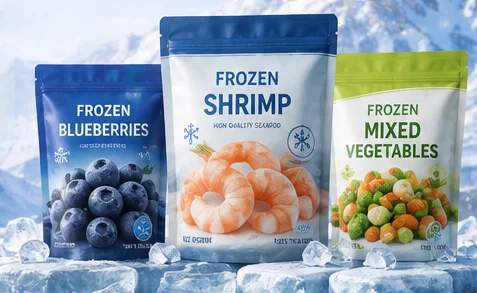
Before finalizing your frozen food packaging, work through this checklist:
1. Know your product characteristics. What are you packaging? Sharp-edged fish portions, uniform vegetables, saucy ready meals, or frozen pet food? Product geometry matters — sharp edges and bone-in cuts place concentrated stress on the film.
2. Define your shelf-life requirements. How long does the product need to stay fresh? Six months? Twelve months? Eighteen months? Higher barrier structures cost more but may be necessary for longer shelf lives.
3. Understand your distribution environment. Will the product travel through multiple temperature zones? Will it be shipped by air? Will it be stacked on pallets? These factors affect seal strength and puncture resistance requirements. By effectively blocking moisture, oxygen, and external contaminants, the packaging helps maintain freshness, flavor, and texture throughout storage and transport.
4. Choose the right material structure. PET/PE for lightweight, low-risk products. PET/NY/PE for sharp-edged products requiring puncture resistance. PET/NY/AL/PE for maximum barrier protection. Mono-material PE for recyclability.
5. Select appropriate pouch features. Stand-up pouch for shelf visibility. Resealable zipper for multi-use convenience. Tear notch for easy opening. Microwave-in-bag for cooking convenience. Anti-fog properties for product visibility.
6. Verify seal integrity. Request seal strength test data from pre-production samples. For food-grade pouches, acceptance thresholds typically range from ≥25 N/15mm to ≥35 N/15mm. Confirm low-temperature seal performance — seals that hold at ambient may fail at -18°C.
7. Test with actual product. Product contamination (sauces, oils, powders) affects seal integrity. Test with your actual product, not empty pouches.
8. Approve a physical sample. Before committing to mass production, approve a sample on your actual material structure with your chosen features. This is your reference for future production batches.
9. Verify supplier capabilities. Not all flexible packaging manufacturers have experience in frozen food. Confirm your supplier has expertise in freezer-grade materials and can provide test data for low-temperature performance.
10. Consider sustainability. Mono-material PE pouches represent the most practical recyclability pathway for flexible frozen food packaging today. However, they may not yet match the barrier performance of multi-layer laminates for the most demanding applications. Evaluate trade-offs carefully.
Once you have clarified these key factors — your product characteristics, shelf-life requirements, distribution environment, and sustainability goals — comparing specific pouch specifications and requesting samples becomes the next logical step.
To explore how different pouch styles and material structures fit various frozen food applications, review WIZ Packaging's preformed pouch capabilities.
For a deeper understanding of how material choices affect barrier performance and sustainability, review WIZ Packaging's materials and sustainability options.
1. Seal Integrity Testing: Key Tips for Food & Pet Food Brands
2. Stand Up Pouches for Pet Treats: Resealable Options & Freshness Protection
3. Understanding Color Deviations When Changing Packaging Stock & Surface Treatments
Chat on WhatsApp
+1 (617) 987-7432