
 English
 Español
 Deutsch
Chat on WhatsApp
+1 (617) 987-7432
You're under pressure to cut packaging waste—from both a cost and a sustainability standpoint. A colleague says rollstock film is the obvious answer because it uses less material per pack. A supplier counters that pre-made stand-up pouches practically eliminate production scrap. Both claims sound reasonable. The truth is that "less waste" depends entirely on where in your production process the waste is being generated—and how much of it you can actually control.
This guide breaks down the real waste profiles of stand-up pouches and rollstock film: where waste originates in each format, how material efficiency differs at different production scales, and what you need to evaluate before choosing a format for your next packaging project.
If you're still exploring which pouch format best suits your product and channel, reviewing the range of available pre-formed pouch styles and capabilities can help you frame the options before diving into the waste comparison.
Before comparing formats, it's critical to understand that "film waste" is not a single number. It comes from multiple sources, and each format shifts the waste burden to a different stage of the value chain.
Rollstock film waste originates at your facility. When you run rollstock on a form-fill-seal machine, you become your own bagmaker. The film is delivered in large rolls, and you are responsible for loading, forming, filling, and sealing. Waste accumulates from:
Edge trim — film trimmed to achieve the correct pouch width
Startup tuning — film consumed during machine calibration at the beginning of each run
Registration drift — misaligned print or seal positioning that forces film to be discarded
Web breaks — torn or stretched film during high-speed operation
Changeover scrap — material wasted when switching between bag sizes or formats
Pre-made pouch waste originates upstream—and mostly stays there. When you use pre-made pouches, the pouch manufacturer absorbs the forming-related waste. By the time pouches arrive at your facility, they are finished products. Any scrap generated during the manufacturing of those pouches is disposed of off-site by the supplier. At your facility, the main waste sources shift to:
Misfeeds — pouches that fail to open or align correctly in the machine
Damaged bags — pouches torn or crushed during handling
Top seal failures — improper seals after filling, often caused by product contamination in the seal zone
This distinction matters because it determines who pays for waste disposal, who bears the labor cost of managing scrap, and how much waste you can realistically eliminate through process optimization. In theory, a pre-made pouch machine can achieve near-zero forming waste because the bags arrive already made—any setup or calibration can be performed without running product, and the pouches can be recycled and used for final production.
The claim that "rollstock uses less material" is often cited as a decisive advantage. The logic is straightforward: rollstock is a continuous sheet of film, while pre-made pouches require individual forming, cutting, and sealing—processes that could introduce extra material consumption.
However, the comparison is more nuanced than it appears at first glance.
| Waste Factor | Rollstock Film | Pre-Made Stand-Up Pouches |
|---|---|---|
| Primary waste location | Your facility (edge trim, setup, drift) | Supplier facility (forming waste, trim) |
| Waste responsibility | You manage and pay for disposal | Absorbed by the pouch manufacturer |
| Typical scrap rate | Higher during setup and changeover; lower during steady-state high-volume runs | Very low—under 0.5% in well-controlled filling operations |
| Waste during changeover | Significant—film must be re-threaded, registration re-established | Minimal—pouches can be run through without product during setup |
| Waste at low volume | Disproportionately high—setup waste is spread over fewer units | Lower—you only pay for the pouches you actually use |
| Waste at high volume (steady state) | Lower per-unit once settings are stable | Still very low, but pouch unit cost is higher |
| Material unit cost | Typically 15–25% lower per package | Higher—includes forming and conversion costs |
A study published in the Journal of Cleaner Production using life cycle assessment methodology found that recycling plastic film provides greater environmental benefit than landfill or incineration, with the mass fraction of film in the waste stream being a key parameter for improving environmental outcomes. The practical takeaway: what matters most for environmental impact is not just how much film you use, but how much of it enters a recycling stream versus going to landfill.
For a deeper look at the material structures that determine whether your packaging is actually recyclable, explore WIZ Packaging's materials and sustainability overview.
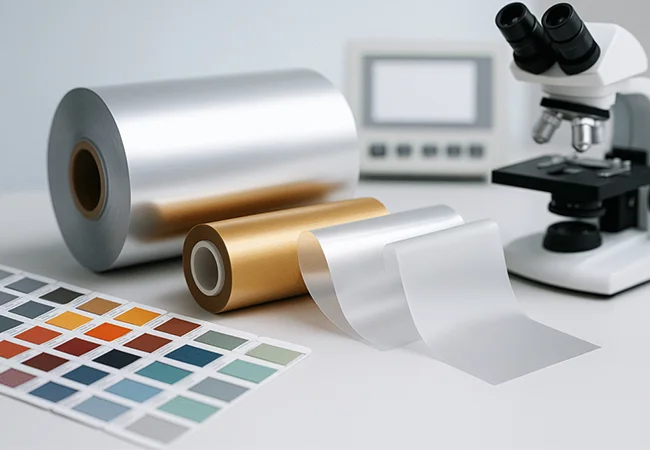
Film waste reduction is only half the equation. The other half is whether the material you do use can actually be recycled in existing infrastructure.
Traditional multi-layer laminates—combining PET, aluminum foil, and PE—provide excellent barrier properties but are notoriously difficult to recycle because the layers cannot be separated economically. This is where the format choice intersects with material science in a way most buyers don't anticipate.
Single-material structures change the waste equation entirely. When a stand-up pouch or rollstock film is constructed from a single polymer family—such as 90% or more polyethylene—it can be recycled in existing PE film recycling streams. A life cycle assessment found that recycling films shows greater environmental benefit than landfill and incineration, primarily because recycled plastics substitute for virgin material production.
This means the "least waste" format is not determined by rollstock vs. pre-made alone—it depends on whether the chosen material can enter a recycling loop after use. A pre-made stand-up pouch made from mono-material PE may have a higher unit cost than a conventional rollstock film, but if the pouch is recyclable and the rollstock film is not, the total environmental waste profile can flip entirely.
The practical implication: When comparing formats, ask the question "what happens to this packaging after the consumer is done with it?" rather than only "how much film is discarded during production?"
There is no single "right" answer. The format that minimizes waste depends on your production volume, SKU complexity, sustainability targets, and where in the lifecycle you want to concentrate your waste reduction efforts.
Step 1: Identify your dominant waste source.
If your facility generates significant scrap from setup, changeover, and machine calibration, rollstock will amplify that waste—you're paying for every meter of film that goes through the machine. If your waste is more concentrated in handling and filling errors, pre-made pouches may shift the problem upstream without eliminating it.
Step 2: Calculate waste at your actual volume.
At low annual volumes (under roughly 500,000 units), setup waste from rollstock is spread across fewer units, making the per-unit waste penalty disproportionately high. At high volumes with stable formats, rollstock's steady-state efficiency improves substantially. Pre-made pouches maintain relatively consistent waste profiles regardless of volume because the forming waste is already accounted for by the supplier.
Step 3: Factor in recyclability.
If your sustainability goals include recyclability, the material structure matters more than the format. A mono-material PE structure—whether supplied as rollstock or as pre-made pouches—is more likely to be recycled than a mixed-material laminate. Ask your supplier for specific recyclability data on the structure you're considering.
Step 4: Evaluate changeover frequency.
If you run multiple SKUs with frequent size changes, the waste generated during rollstock changeover—film re-threading, registration reset, and startup tuning—can accumulate rapidly. Pre-made pouches allow you to calibrate the machine without running product, reducing changeover waste to near zero.
To see how different industries apply these formats in practice, browse WIZ Packaging's food and beverage packaging solutions for snacks, pet food, beverages, and nutritional products.
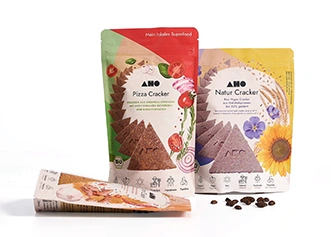
Scenario A: Mid-Sized Snack Brand with Seasonal SKUs
You produce roasted nuts and trail mixes in 8oz and 12oz formats, with seasonal flavor launches that require new packaging designs two to three times per year. Your annual volume is roughly 800,000 pouches.
Key waste consideration: Each new SKU launch requires packaging changes—new print artwork, possibly different bag dimensions. With rollstock, every launch triggers setup waste as the machine is re-calibrated. With pre-made pouches, you order the new pouch design and run it without machine setup waste. Over three launches per year, the pre-made pouch format reduces cumulative changeover waste significantly—even though the per-unit pouch cost is higher.
Scenario B: High-Volume Coffee Roaster
You package whole bean coffee in 12oz stand-up pouches with degassing valves, running 50,000 units per day on a consistent format year-round. Your annual volume exceeds 12 million pouches.
Key waste consideration: At this volume, the material cost difference dominates. Rollstock film eliminates the forming cost embedded in pre-made pouches, and with a stable format and mature machine settings, steady-state waste is minimal. The 15–25% material cost savings on custom rollstock film translates to substantial annual savings. However, the degassing valve requirement complicates rollstock—adding a valve to a form-fill-seal line requires specialized equipment and introduces additional failure points. For valve-equipped pouches, pre-made formats are often the more practical choice regardless of volume.
Once you've identified where your waste actually originates and what your recyclability requirements are, the next step is translating those findings into a concrete material specification. The key factors to document before evaluating specific options:
Waste source map: Which stage of your production generates the most film waste—forming, filling, changeover, or post-consumer disposal?
Volume threshold: Are you above or below the point where rollstock material savings outweigh setup waste?
Recyclability requirement: Does your sustainability target require a mono-material structure, or is a conventional laminate acceptable?
Format constraints: Does your product require a valve, spout, zipper, or specific stand-up shape that limits format options?
Once you have clarified these decision factors, comparing the specific material structures and format capabilities of available options becomes the next logical step. You can review WIZ Packaging's pre-formed pouch capabilities for premium retail formats with complex features, or explore custom rollstock film options for high-volume VFFS-compatible production.
How Packaging Format Affects Film Waste: A Production Manager’s Guide
Pre-Made Pouches vs Rollstock: A Long-Term Value Comparison
Mono-Material vs Multi-Layer Film: Recyclability and Waste Trade-Offs
Chat on WhatsApp
+1 (617) 987-7432